
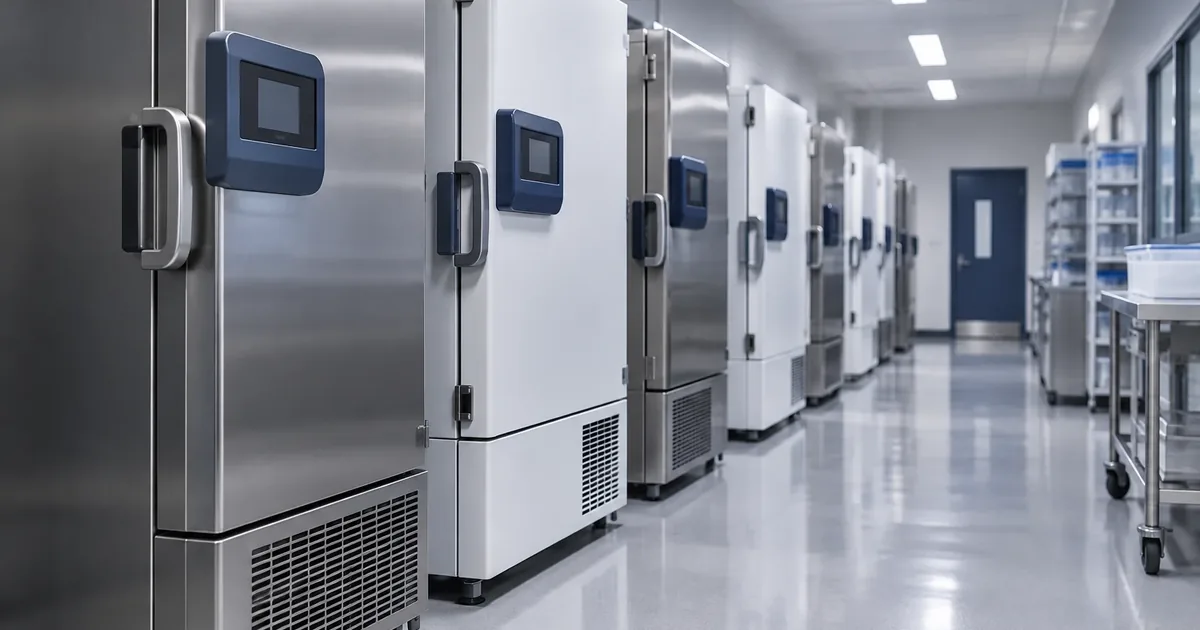
Monitoring ultra-low freezers at minus 80 degrees protects vaccines, reagents and biological samples that even a brief temperature excursion can destroy. Continuous visibility from wireless temperature sensors catches a failing compressor or a door left ajar long before a manual log check would, giving your team time to act before a loss becomes irreversible.
By Kevin Keithley, Director of Marketing, Swift Sensors
Where Should You Place the Temperature Probe in an Ultra-Low Freezer?
Getting each setting right is what monitoring ultra-low freezers at minus 80 actually requires, and it starts with where the probe sits. Probe placement determines whether a reading reflects what your samples actually experience or just the air nearest the freezer wall. In an ultra-low temperature (ULT) freezer, place the primary probe in the geometric center of the chamber, on a middle shelf, away from the door seal, the evaporator coil and any air vent. Air near the door swings several degrees every time someone opens it; air near the coil runs colder than the rest of the chamber. Neither location represents the true storage temperature.
For a two-door or multi-compartment ULT freezer, place one probe in each independently cooled section rather than assuming both sides track together. A freezer that stores both liquid reagents and dry biological material benefits from a probe positioned near the densest, most temperature-sensitive load, since that material buffers temperature swings more slowly than open air and shows the excursion your team actually needs to know about.
What Buffer Solution Should You Use for a Minus 80 Freezer Temperature Probe?
A bare probe measures air temperature, which swings within seconds of a door opening even though the frozen samples inside barely move. A buffer solution, typically glycerol, propylene glycol or a small vial of glass beads, gives the probe tip a thermal mass close to what a vial of liquid or a box of samples actually experiences. The probe reads the buffer's temperature instead of the air, so the alarm reflects real product risk rather than a few seconds of open-door air exchange.
Without a buffer, a probe left in open air will trip an alarm nearly every time the door opens, even during a five-second sample retrieval that never puts stored material at risk. That pattern trains staff to ignore alerts, which is more dangerous than having no monitoring at all: a real temperature excursion during a compressor failure gets lost in the noise of routine false alarms.
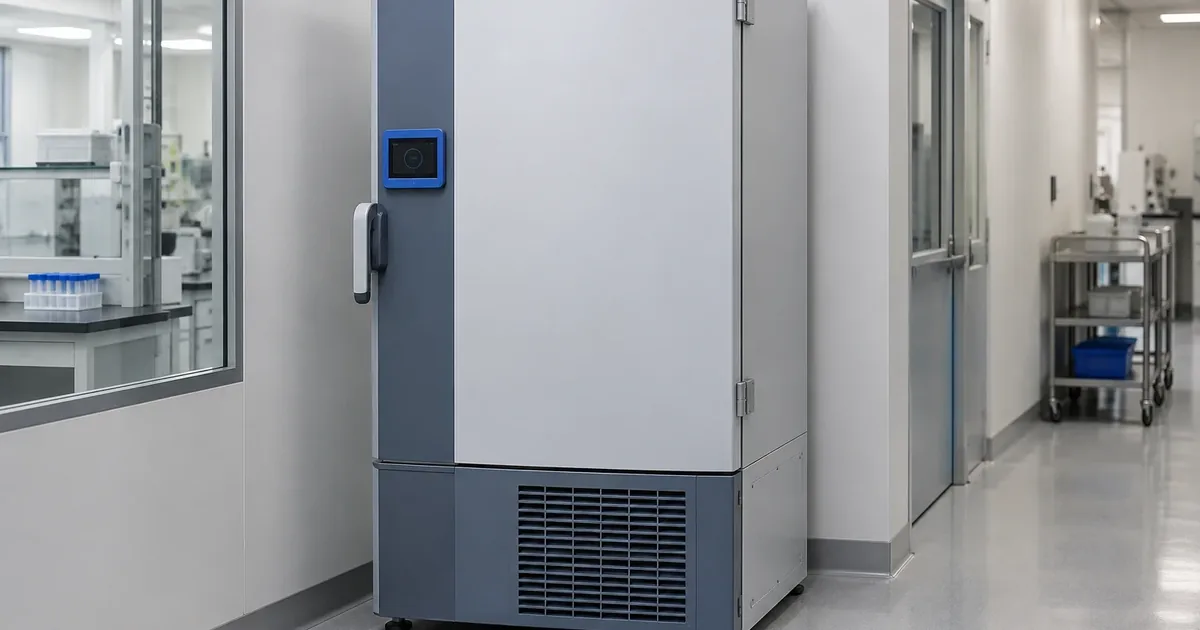
Alarm Thresholds for Monitoring Ultra-Low Freezers at Minus 80
Alarm thresholds on a minus 80 freezer need enough margin to ignore normal compressor cycling but tight enough to catch a real problem before samples warm past a safe range. Many facilities set the high alarm around 10°C above the operating setpoint, so a freezer running at minus 80°C alarms around minus 70°C, and set a low alarm a few degrees below setpoint to catch a runaway compressor. The right number depends on what's stored: material with a hard temperature ceiling for stability may need a tighter threshold than general-purpose cold storage, so confirm the specific limit with whoever owns the stored material's requirements rather than applying one setting to every unit.
How Long Should Alarm Delays Be So Door Openings Don't Trigger False Alarms?
An alarm delay, sometimes called a debounce window, holds off notification until an out-of-range reading persists for a set period rather than firing the instant a door opens. A delay of several minutes is common for ULT freezers because a properly buffered probe rarely shows a real excursion that fast, while an unbuffered probe reading air temperature would trigger constantly without one. The goal is a delay short enough to still catch a genuine compressor failure quickly, but long enough that a routine door opening for sample retrieval never generates an alert your team has to dismiss.
Calibration, Probe Counts and What Counts as Ultra-Low Storage
How Often Should Ultra-Low Freezer Probes Be Calibrated and Verified?
Most labs calibrate ULT freezer probes at least annually, with more frequent verification in regulated environments or after any event that could affect accuracy, such as a probe swap or a significant power interruption. Swift Sensors offers NIST calibration services through an independent ANAB ISO 17025:2017 accredited laboratory. The standard calibration points run from minus 50°C to plus 150°C, so a calibration point near minus 80°C is arranged through another accredited laboratory; ask for it when you order, so the certificate covers the temperature the probe actually works at. Check with your accrediting body or quality manager for the specific interval your program requires, since CAP, CLIA and internal quality programs don't all set the same schedule.
How Many Probes Does a Single Ultra-Low Freezer Need?
A single, well-mixed low-temperature ULT freezer chamber typically needs one probe positioned at the center of the load. Larger chambers, freezers with known cold or warm spots, or units that store material across multiple shelves with different airflow exposure often benefit from two or more probes, so a localized problem doesn't go undetected simply because it happened outside the one spot being measured. When in doubt, compare readings from a few points in the chamber during commissioning and add probes anywhere the reading diverges meaningfully from the rest of the unit.
What Temperature Range Counts as Ultra-Low or Minus 80 Storage?
Ultra-low temperature freezer storage generally refers to units operating between minus 40°C and minus 86°C, with minus 80°C the most common operating point for long-term biological sample storage. That range sits well below standard laboratory freezer temperatures of roughly minus 20°C, and it's cold enough to essentially stop the biological and chemical degradation that would otherwise compromise stored reagents, cell lines and specimens over months or years.
How Remote Monitoring Protects Samples During a Power Outage or Compressor Failure
A compressor failure or a building power outage doesn't wait for business hours, and a can't-fail freezer full of irreplaceable samples needs eyes on it around the clock, not just during a daily walk-through. Wireless sensors paired with a gateway report readings continuously to the Swift Sensors Cloud Console, and instant alerts via email, SMS or phone call reach your team the moment a reading goes out of range, whether that happens at 2 p.m. or 2 a.m.
That always-on visibility matters most in facilities running scientific lab monitoring for research freezers, blood bank storage, biorepositories and specimen archives, where a single ULT freezer can hold years of irreplaceable material. Many of these environments pair remote temperature monitoring with a backup cooling plan, such as a liquid carbon dioxide or dry ice backup system that engages automatically if primary power or compressor function is lost, buying hours instead of minutes before samples are at risk. Monitoring doesn't replace that backup system, but it's what tells your team the backup engaged, how long it's been running, and when it needs attention, all without disruption to daily operations.
Frequently Asked Questions
Is continuous temperature monitoring required for CAP or CLIA compliance?
CAP and CLIA generally expect documented, ongoing temperature monitoring for freezers storing regulated specimens, reagents or biological material, though the exact requirement depends on your specific accreditation checklist and lab type. Continuous wireless monitoring with logged, timestamped readings makes it easier to demonstrate compliance during an inspection than manual spot-checks, but confirm the exact monitoring frequency and documentation standard your accrediting body requires for your facility.
What is considered ultra-low temperature storage?
Ultra-low temperature storage typically covers freezers operating from about minus 40°C down to minus 86°C, with minus 80°C the most common setpoint for long-term storage of biological samples, reagents and some vaccines. That's substantially colder than a standard lab freezer's minus 20°C, and it's the range where most biological degradation effectively stops for extended periods.
Can opening a minus 80 freezer door trigger a false alarm?
Yes, briefly, if the probe reads air temperature directly. Opening the door lets warmer air in, which an unbuffered probe registers instantly even though the frozen samples barely change temperature. A buffered probe and an alarm delay of several minutes together filter out that normal air swing, so a routine door opening for sample retrieval doesn't generate an alert.
Do ultra-low freezers need backup power?
Most facilities storing irreplaceable samples pair their ULT freezers with some form of backup, whether that's a facility generator, a backup power supply for the monitoring gateway itself (Swift Sensors' Mini Backup Power Supply runs a gateway for 12 to 15 hours), or a liquid CO2 or dry ice backup cooling system for the freezer. Remote monitoring doesn't replace that backup, but it confirms the backup engaged and alerts your team if temperatures still climb.
Get Continuous Visibility Into Your Ultra-Low Freezers
If a compressor failure or a power outage happened tonight, would your team find out before samples were at risk, or during tomorrow's walk-through? Explore how ultra-low freezer monitoring from Swift Sensors brings continuous visibility, instant alerts and out-of-range notifications to ULT freezer monitoring, with no disruption to your daily operations.

