Warehouse Temperature Monitoring for Cold Storage
Let's Get Started
Ask a Question • Get a Quote • Request a Demo
Temperature Monitoring for Cold Storage Warehouses
Cold storage failures rarely announce themselves. A compressor that falters on a Saturday night, a freezer door left ajar after a late shipment, or a staging area that warms up during a heat wave can damage inventory and put a food safety audit at risk long before anyone walks the floor. Warehouse temperature monitoring built on manual logs leaves gaps between rounds, and those gaps are where the costliest temperature excursions happen.
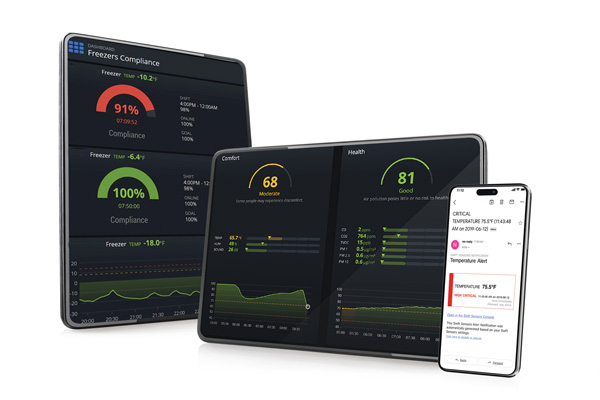
Swift Sensors wireless temperature and humidity sensors provide continuous, real-time monitoring across every cold zone in your facility, from walk-in coolers and blast freezers to climate-controlled staging areas and dry storage. The Swift Sensors Cloud Console records every reading, sends instant alerts via email, SMS, or phone call the moment a zone goes out of range, and builds the compliance reports and sensor data histories your auditors ask for. Door sensors and temperature sensors work together, so when a refrigeration unit falters or a door is left open, your team can take corrective action in minutes, not hours. Scalable and entirely wireless, Swift Sensors can be deployed across a single cold room or an entire network of distribution facilities with no disruption to daily operations. The result is a warehouse temperature monitoring system that protects your inventory, helps document compliance with FDA and USDA food safety requirements, and gives your team continuous visibility without another round of manual checks. View case study.
- Easy-To-Deploy Wireless Sensors
- Instant Critical Mobile Alerts
- Enterprise Cloud Monitoring Software
- Low-Cost Straightforward Monitoring Plan
- Robust Analytics and Compliance Reports
Remote Monitoring
System Components
Protect Your Business & Your Reputation
Swift Sensors is an easy-to-deploy, scalable monitoring and alerts solution driven by wireless sensors. Send instant alerts via email, SMS, or phone call for events that require immediate corrective action. Protect your business and your reputation from avoidable downtime, loss of assets, and preventable regulatory challenges.
Exceptional Return on Investment
Aliments ASTA was looking to gain insight into the performance characteristics of it’s highly complex protein processing work flow. View case study.
Example: two refrigerators and a freezer
- $1,050 Year 1: Hardware, Monitoring Plan
- $225 Year 2: Monitoring Plan
- $225 Year 3: Monitoring Plan
Compare to potential expenses:
- Lost food and beverage inventory
- Lost reputation from service disruptions
- Regulatory fines and resubmissions
- Time and labor for manual temperature logging
- Legal fees due to foodborne health issues
Temperature and Humidity Monitoring for Warehouses
Warehouse
Food storage warehouses depend on precise temperatures to prevent spoilage and reduce waste. Wireless sensors can cover every zone, and their records support food safety compliance.
Reefer Units
Reefer unit monitoring safeguards perishable cargo at the dock and can extend to storage in transit, flagging a unit that drifts out of range before spoilage sets in.
Cold Rooms
A cold room temperature monitoring system from Swift Sensors tracks every room around the clock and alerts staff when temperatures move out of range.
Production Floor
Temperature on the production floor affects food safety and product quality. Ambient temperature and humidity sensors track conditions by zone and alert staff when a room runs warm.
Best Wireless Sensors For Warehouses
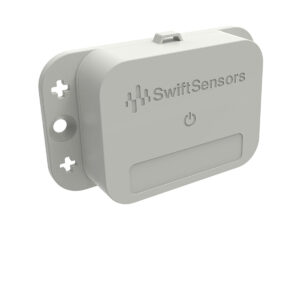
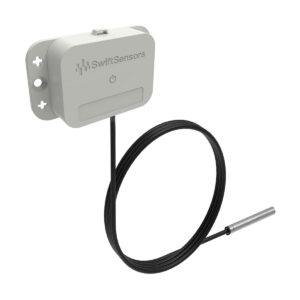
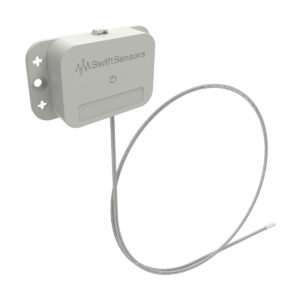
Commercial refrigerators, freezers, and cold rooms hold safe, precise temperatures only as long as the equipment keeps up with the load. Each warehouse sensor from Swift Sensors is smaller than a credit card, installs without wiring, and can report to the Swift Sensors Cloud Console as often as every minute. Probe sensors such as the SS3-105S measure from -40°F to +257°F, the SS3-110 ultra-low temperature sensor reaches -148°F for deep-freeze storage, and the SS3-101 tracks ambient temperature and relative humidity in staging areas and dry storage. Water detection puck sensors watch for leaks and flooding. Thresholds, schedules, and alerts can be customized to account for dock door openings and other expected activity.
How a Warehouse Temperature Monitoring System Works
A cold storage monitoring system has three jobs: measure every zone continuously, tell the right people the moment something goes out of range, and keep a record that holds up at audit time. Swift Sensors handles each one with three components:
Wireless sensors in every zone
Temperature, humidity, door, and water detection sensors mount in and around freezers, coolers, cold rooms, and staging areas. They run on replaceable batteries, with an average life of 6 to 8 years for most models.
Gateways that carry the data
Each gateway supports up to 150 sensors over Bluetooth 5 (BLE5), with a range of 100 m line of sight or 30 m non line of sight, and passes readings to the cloud over ethernet, WiFi, or an optional cellular module. Large buildings add gateways as coverage requires.
The Swift Sensors Cloud Console
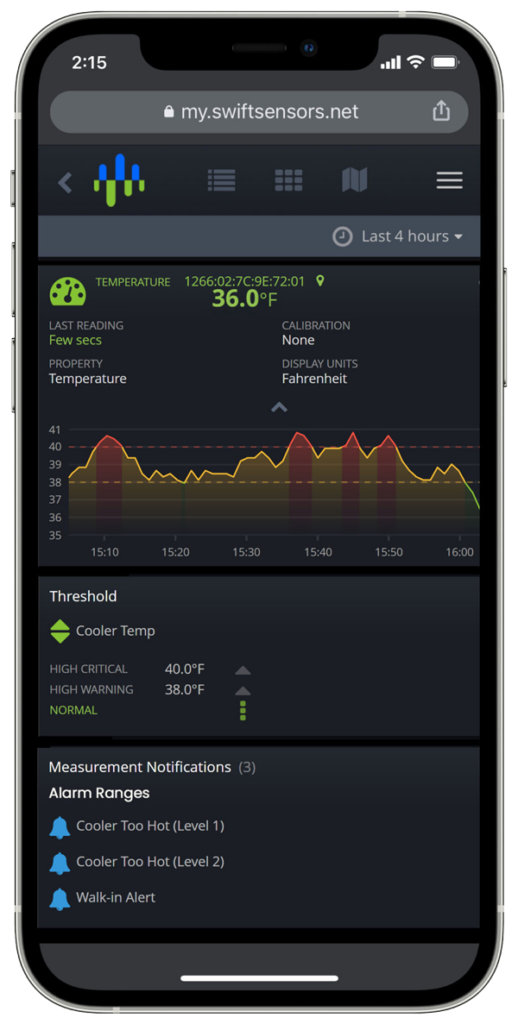
Automated monitoring and alerts run here. Set thresholds and schedules for each zone, route instant alerts via email, SMS, or phone call to individuals or groups, and escalate an unacknowledged alert through further tiers of contacts. Your team can add corrective action notes to the alert and the graph, and the Daily Extremes report gives you each zone’s daily minimum and maximum, downloadable on any device.
For food warehouses, that record matters. Under the FSMA preventive controls rule (21 CFR Part 117), covered facilities document temperature control as a preventive control in a written food safety plan, and continuous electronic records make that documentation far easier to produce. Swift Sensors supports those requirements and helps document compliance, while your food safety plan and your auditors define what compliance means for your facility. For sensors that need traceable accuracy, Swift Sensors offers NIST Calibration services through an independent ANAB ISO 17025:2017 accredited laboratory.
The Swift Sensors Cloud Console also features an API that can be used to communicate with third-party applications, which is how temperature data can reach the other software your warehouse team already relies on.
Cold Storage Monitoring Through a Power Outage
A power outage is one of the fastest ways a cold storage warehouse loses product, and it tends to happen when nobody is there: a storm, an overnight grid problem, a tripped breaker on a holiday weekend. Freezers and coolers hold their temperature for a while with the doors closed, then begin to warm. What decides the outcome is how quickly your team finds out.
Swift Sensors is built to keep reporting through that window:
Sensors run on batteries
Every Swift Sensors wireless sensor has its own replaceable batteries, so it keeps measuring when facility power drops.
The gateway can ride through the outage
The optional Mini Backup Power Supply (SS-UPS-15-US) installs inline with the gateway and keeps it running for approximately 12 to 15 hours during a power outage, preserving sensor data collection and cloud connectivity.
Connectivity does not have to depend on the building network
With the optional cellular network module, the gateway can reach the cloud even if the facility's own network equipment goes down with the power. If the connection does drop while the gateway still has power, the gateway stores readings and uploads them when the connection returns.
Power loss at the unit can raise its own alert
The SS3-603 Wireless Contact/Switch Sensor can alert on loss of power to a freezer or compressor, so your team hears about the outage itself, not only the temperature that follows.
Silence raises an alert too
If a gateway or sensor stops reporting, for example a gateway that loses power with no backup supply, the Swift Sensors Cloud Console sends an alert.
Alerts reach people off site
As temperatures climb, instant alerts via email, SMS, or phone call reach your on-call team wherever they are.
The record stays complete
The Swift Sensors Cloud Console keeps up to 5 years of temperature history, including the full record of the event, which is what your quality team will want to review afterward.
A little planning makes the difference. Put each gateway on a backup supply, make sure your alert contacts include someone who is always reachable, and review alert schedules so after-hours alerts go to the right person.
Testimonials
FAQ
What are the best wireless sensor options for real-time temperature monitoring in cold storage warehouses?
It depends on the zone. Probe sensors such as the SS3-105S suit coolers and freezers, because the probe can reach inside the unit. The SS3-110 ultra-low temperature sensor covers deep-freeze storage down to -148°F. The SS3-101 ambient temperature and humidity sensor fits staging areas, dry storage, and production rooms. Door sensors and water detection sensors round out a cold storage monitoring setup, and every sensor reports in real time to the Swift Sensors Cloud Console.
Which temperature and humidity sensors help with food safety compliance in refrigerated storage?
Look for sensors that record continuously, alert on temperature excursions, and can be calibrated to a traceable standard. Swift Sensors temperature probe sensors and the SS3-101 temperature and humidity sensor report as often as every minute, store every reading in the Cloud Console, and can be NIST calibrated through an independent ANAB ISO 17025:2017 accredited laboratory, with renewal on the calibration cycle you set, managed by Swift Sensors. That supports the monitoring and record-keeping side of FSMA and HACCP plans. The plan itself still defines your limits and corrective actions.
Can Swift Sensors work with inventory or warehouse management software?
The Swift Sensors Cloud Console features an API that can be used to communicate with third-party applications, so temperature and humidity data can be shared with other systems your team uses. How it connects to a specific inventory or warehouse management platform depends on that platform, so ask the Swift Sensors team about your software before you plan an integration.
How many sensors does a warehouse need?
Plan on at least one temperature sensor per freezer, cooler, or cold room, and more in large rooms where conditions can differ between the door and the back wall. Add humidity sensors where product quality depends on it, and door and water detection sensors where they matter most. Each gateway supports up to 150 sensors, and larger buildings add gateways as coverage requires. The Swift Sensors team can help size a system for your facility.
How does the Swift Sensors system work?
A Swift Sensors system requires the purchase of at least one gateway, at least one sensor, and a monitoring plan.
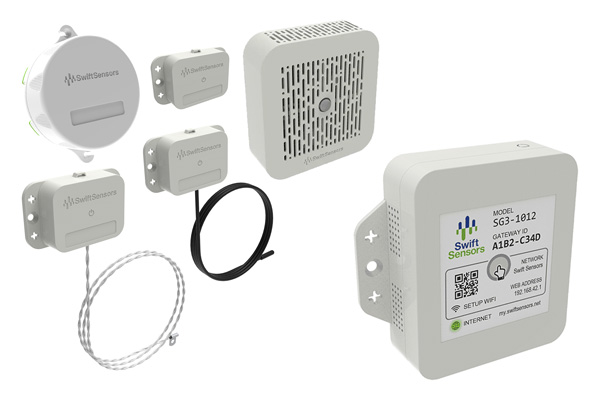
- Swift Sensors wireless sensors measure temperature, humidity, door activity, water leaks and other critical conditions. Each sensor is smaller than a credit card and has battery life of 6-8 years. The sensor transmits data via Bluetooth 5 (BLE5) and connects to the gateway with a push of a button.
- The gateway receives data from each sensor and then transmits the data to the cloud console via local ethernet, WiFi, or cellular network (optional module). Each gateway supports up to 150 sensors within 100 m line of sight (30 m non line of sight).
- The monitoring plan is very simple. The fee is based on the number of sensors you deploy. You can pay monthly, annually, or multi-year. There are no contracts required. View real-time analytics, download compliance reports, and receive instant mobile alerts on any device.
What is the signal range of the sensors?
The sensor range is generally 100 m line of sight (30 m non line of sight) depending on the facility infrastructure and equipment located between the sensor and the gateway. The SS3-901 and SS3-902 reach 200 m line of sight and 60 m non line of sight. The sensors use the BLE5 wireless communication protocol which allows signal transmission through doors and walls constructed of standard building materials.
What is the battery life of the sensors?
Each sensor uses two AAA lithium polymer batteries with an average lifespan of 6-8 years. Replacement batteries are readily available at hardware stores and various retail locations.
How does the monitoring plan work?
The monitoring plan is very simple. The fee is based on the number of sensors you deploy. You can pay monthly, annually, or multi-year. There are no contracts required.
What is the Swift Sensors Console?
The Swift Sensors Console is a robust cloud-based monitoring, alerts, and reporting platform viewable remotely on any device. The Console is used for hardware setup and system configuration. The Console presents analytics that provide trend analysis, historical documentation, compliance reporting, and deep insights into equipment performance, facility operations, and environmental conditions. The platform is customizable and adaptable to any industry with unparalleled ability to search, filter, sort and view critical measurement and performance data. Configurable instant alerts enable immediate corrective actions when significant events occur. Alerts can be sent to individuals or groups via SMS text, email, or voice.
What about system security?
The Swift Sensors monitoring, alerts, and reporting platform was developed and is maintained by industry experts with extensive experience in network security. Sensor to gateway communication utilizes BLE5 and 128-bit AES encryption. Gateway to cloud Console communication utilizes ethernet, WiFi, or cellular (optional module) and 256-bit AES encryption. Data is securely transmitted over Secure Sockets Layer (SSL) on port 443. The Swift Sensor network does not allow any outside communication. As a result, the Swift Sensor network is incredibly secure.
Can I buy just the sensors?
Swift Sensors only communicate with Swift Sensors gateways. Swift Sensors gateways only communicate with the Swift Sensors Console. The Swift Sensor network does not allow any outside communication. As a result, the Swift Sensor network is incredibly secure. The Swift Sensor Console, however, features a robust API which can be utilized to communicate with 3rd-party applications.
Insights, Innovations
and Installations
Related Monitoring Solutions
See Swift Sensors in Your Warehouse
Share how many freezers, coolers, cold rooms and storage zones you need to cover. A Swift Sensors specialist will follow up with a quote, a walkthrough of the Cloud Console, or answers to your questions.
- Wireless sensors that install without running wire
- Alerts by email, SMS or phone call, with escalation
- Monitoring plan billed monthly, annually or multi-year, no contracts
- NIST calibration through an ANAB ISO 17025 accredited lab
Prefer to talk? Call 512-256-7552
Ask a Question • Get a Quote • Request a Demo