Wireless Temperature Sensors

Temperature is the single most consequential environmental measurement across commercial operations, and a wireless temperature sensor is the simplest way to watch it continuously. Temperature decides whether pharmaceuticals retain their efficacy, whether food inventory is safe for consumption, whether industrial processes remain within specification, and whether equipment is operating within safe thermal limits. Yet temperature monitoring remains among the most poorly executed compliance requirements in commercial facilities. Manual log sheets introduce transcription errors and coverage gaps, single-sensor placements miss the zone-level variation that causes the costliest failures, and a reading taken after an excursion does nothing to prevent the product loss, regulatory citations and liability exposure that follow.

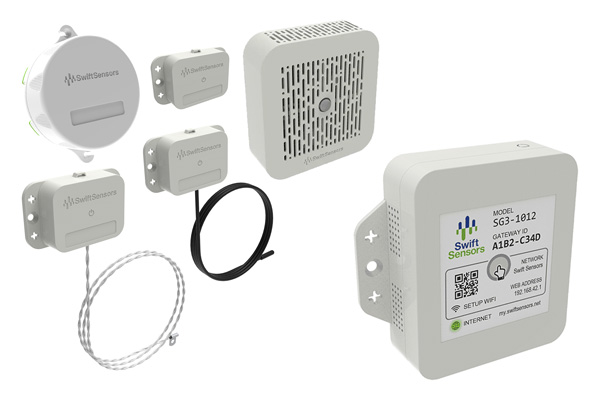
Swift Sensors offers a family of temperature sensors engineered for the full range of commercial and industrial monitoring demands, from ultra-low deep freeze environments and pharmaceutical cold chain storage to ambient facility monitoring, industrial process equipment and remote assets. Each sensor reports over Bluetooth 5 (BLE5) to a gateway, and the gateway sends the data to the Swift Sensors Cloud Console over ethernet, WiFi or cellular. Together they form a complete wireless temperature monitoring system, with every unit working as a remote temperature sensor you can check from any device. The moment any sensor detects a reading outside its configured range, instant alerts via email, SMS, or phone call reach your designated team so corrective action can be taken before inventory is compromised. NIST Calibration through an ANAB ISO 17025:2017 accredited laboratory, combined with automated compliance reports, delivers the documented, timestamped temperature record that health departments, auditors, insurance carriers and quality programs expect to see.

The Best Wireless Temperature Sensors

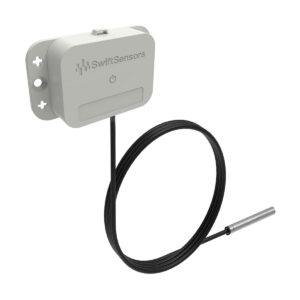
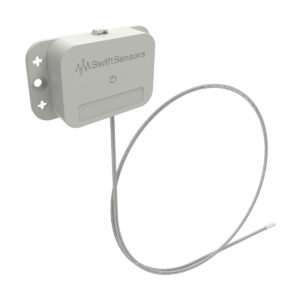
The most popular Swift Sensors models combine accuracy, durability, and long battery life, making them the go-to choice for businesses across industries. The SS3-101 measures ambient temperature and relative humidity in rooms, storage areas and cabinets. The SS3-103 carries a 1m ring lug probe for surface readings on pipes and equipment. The SS3-105S places a 1m stainless steel probe inside refrigerators, freezers and liquids, reading from -40°C to +125°C. The SS3-110 extends the range to ultra-low freezers, from -100°C to +32°C. Trusted in food processing, healthcare, and industrial applications, Swift Sensors delivers reliable monitoring and reporting that supports a variety of health, safety and quality regulations.

Swift Sensors Wireless Temperature Sensors

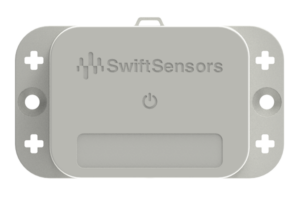
Swift Sensors wireless temperature sensors feature:

  • No wiring required
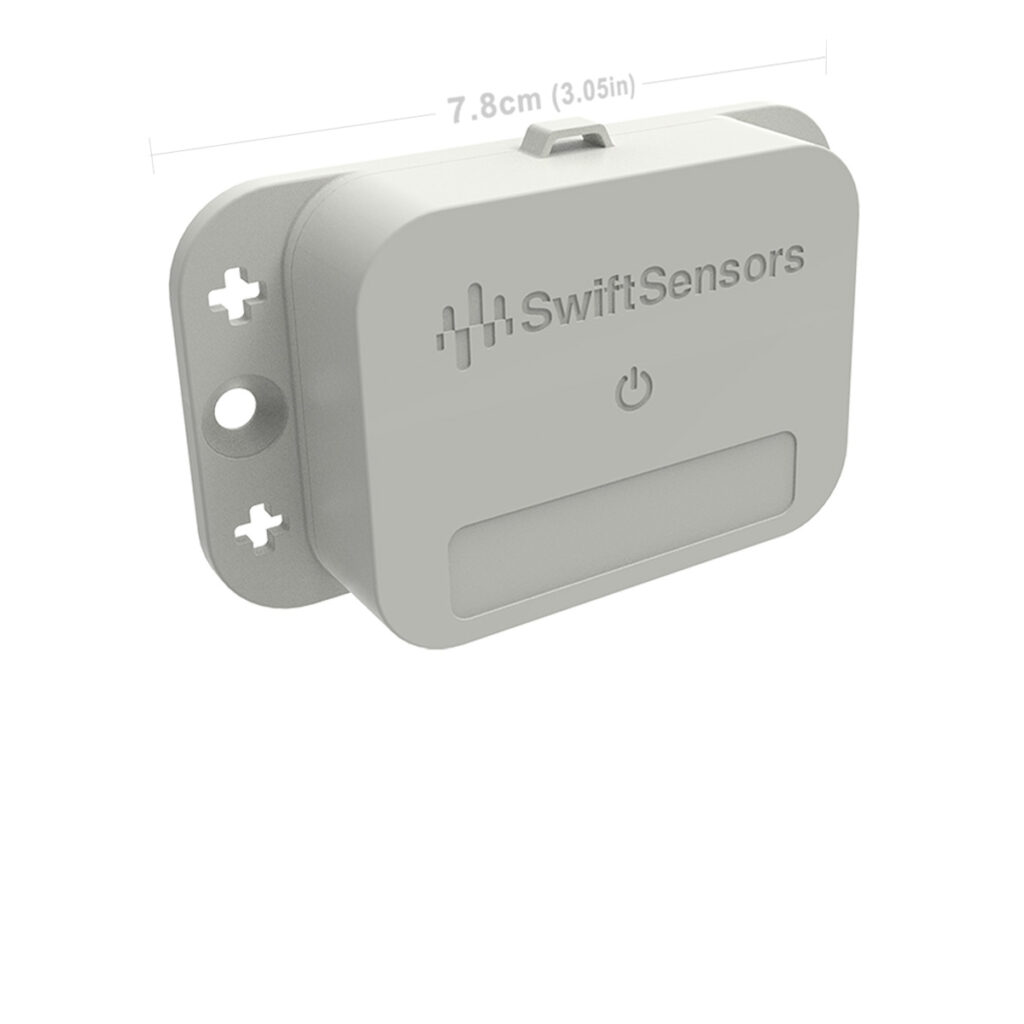
  • Smaller than a credit card
  • Push-button connectivity
  • 6-8 year battery life
  • Secure Bluetooth 5 (BLE5) communication
  • IP66 Rating (dust proof and water resistant)
Swift Sensors offers NIST Calibration Services

NIST Calibration Services

Swift Sensors offers NIST Calibration services through an independent ANAB ISO 17025: 2017 accredited laboratory. Swift Sensors manages all calibration logistics prior to initial sensor delivery and ensures seamless annual calibration renewal.

Swift Sensors Wireless System Overview

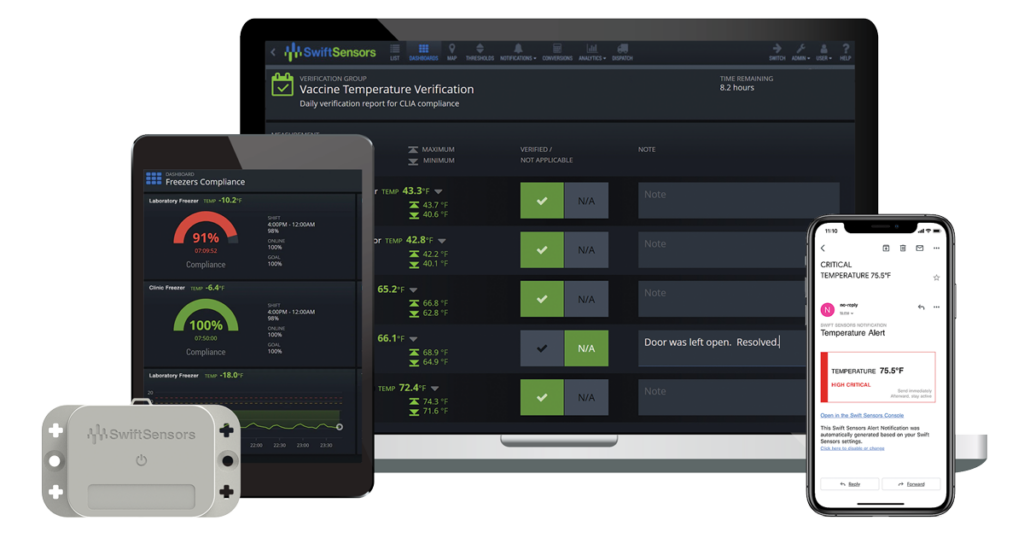
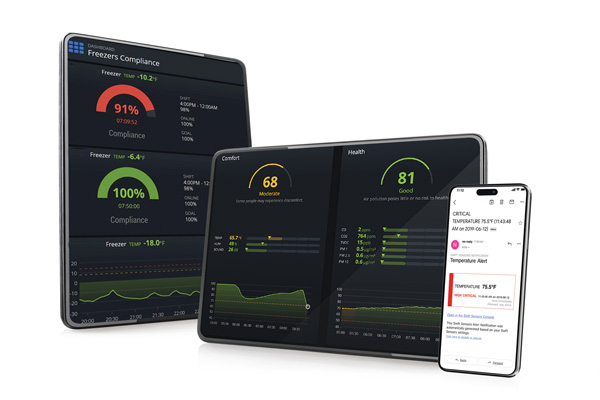
View temperature data on any device in real time.

Protect Your Business and Your Reputation with Wireless Temperature Sensors

Swift Sensors is an easy-to-deploy, scalable monitoring and alerts solution driven by wireless sensors. Send instant alerts via email, SMS, or phone call for events that require immediate corrective action. Protect your business and your reputation from avoidable downtime, loss of assets, and preventable regulatory challenges.

Remote Temperature Monitoring Over WiFi, Ethernet, or Cellular

A sensor is only as useful as the connection behind it. Many facilities start by searching for a WiFi temperature sensor or a cellular temperature monitor, but the real question underneath is simpler: will the readings reach your team from wherever the equipment sits? Swift Sensors answers that with a two-step design. The sensors communicate over Bluetooth 5 (BLE5), which is what makes push-button pairing and a 6-8 year battery life possible. They do not join your WiFi network one by one. Each sensor reports to a Swift Sensors gateway, and the gateway carries the data to the Swift Sensors Cloud Console over the connection your site already has:

Ethernet

Connect the gateway to your local network. The SG3-1010 gateway can also be powered with active PoE.

WiFi

The SG3-1010-XR gateway supports 2.4 GHz and 5 GHz WiFi, so there is no network cable to run.

Cellular

Add the SG3-CNM-03 Cellular Network Module (LTE) for remote locations and small offices with no IT support or local network, or as a redundant backup to the WiFi or ethernet connection. A cellular data plan is required.

One gateway, up to 150 sensors

One gateway supports up to 150 sensors within 100 m line of sight (30 m non line of sight), so a single connection can cover a whole kitchen, lab or warehouse zone. Data is encrypted along the way, with 128-bit AES from sensor to gateway and 256-bit AES from gateway to the Console. If the internet connection drops, the gateway stores readings as long as it has power and uploads them when the connection returns, and the Console can alert your team when a gateway or sensor stops reporting. Where facility power is unreliable, the SS-UPS-15-US Mini Backup Power Supply keeps the gateway running through brief outages. The result is remote temperature monitoring that keeps working whether or not your IT team is on site, with every location visible in one Console.

Healthcare Guide

Food Processing Guide

Wireless Temperature Sensors for any Industry

Testimonials

Swift Sensors Wireless Temperature Sensor FAQs

Not directly, and that is by design. A WiFi temperature sensor transmits straight to your wireless network, so every sensor needs its own IP address. Swift Sensors temperature sensors talk to a gateway over low-energy Bluetooth 5 (BLE5), and the gateway connects to the Swift Sensors Cloud Console over WiFi, ethernet or cellular. Because no sensor needs an IP address, there is less IT overhead and cost. BLE5 transmission also drains batteries more slowly than WiFi, so batteries last longer (6-8 years on average) and maintenance stays low. You still get what you want from a WiFi sensor: live readings and alerts on any device.

Yes. For remote locations, small offices and sites with no IT support, the SG3-CNM-03 Cellular Network Module connects to the gateway by USB and sends data over LTE, turning the system into a cellular temperature monitor that needs no local network at all. A monthly or annual cellular data plan is required. The module can also serve as a redundant backup to a WiFi or ethernet connection, so alerts keep flowing if the building network goes down.

The terms overlap. In industrial settings, wireless temperature transmitters convert a sensing element’s signal and send it to a control or monitoring system. Every Swift Sensors temperature sensor does that job: the sensing element takes the reading and a built-in BLE5 radio transmits it to the gateway, at an inspection rate you can set from 1 to 30 minutes (5 minutes by default). The difference is what happens next. The Swift Sensors Cloud Console stores every reading, shows the trend, and sends alerts when a reading goes out of range. The SS3-117 Wireless Universal 2-Channel Thermocouple Adapter extends the system to a wide range of standard thermocouples, new or already deployed, bringing their readings into the Console with the same alerts and reporting.

A Swift Sensors system requires at least one gateway, at least one sensor, and a monitoring plan. The sensors take the readings, the gateway sends them to the cloud, and the monitoring plan gives your team the Swift Sensors Cloud Console for real-time analytics, compliance reports and instant alerts via email, SMS, or phone call. NIST Calibration through an ANAB ISO 17025:2017 accredited laboratory is available for sensors that need documented accuracy, and Swift Sensors manages the renewal.
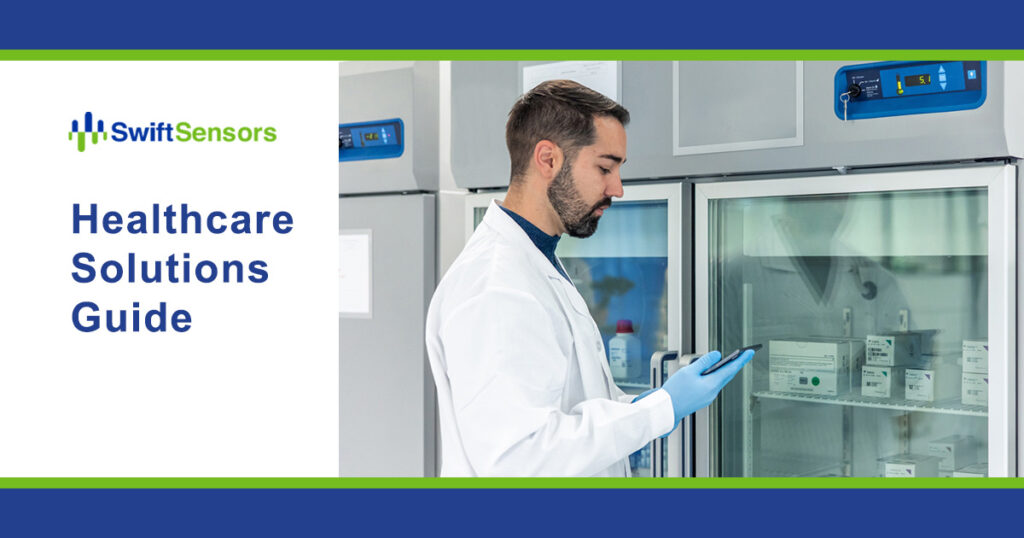
Wireless temperature sensors are electronic devices designed to measure and transmit temperature data without the need for physical cabling. Unlike traditional wired sensors, wireless sensors communicate via a variety of technologies to send data to an onsite server or cloud platform. This makes them highly flexible and easy to install in areas where wiring is impractical or costly.

Swift Sensors
Swift Sensors communicates data via Bluetooth 5 (BLE5). With the push of a button, the sensors automatically connect to the closest gateway which communicate data securely to the cloud via ethernet, WiFi or cellular. The Swift Sensors cloud Console receives the data and instantly converts complex measurements into easy-to-understand, actionable analytics.

Learn more about Swift Sensor system components.

Wireless temperature sensors operate in two main steps: detection and transmission.

  • Detection: A sensing element (such as a thermistor or RTD) measures the ambient temperature. This element converts thermal changes into an electrical signal.

  • Transmission: The sensor’s built-in wireless module transmits data via a variety of technologies to an onsite server or cloud platform.

Swift Sensors
Swift Sensors detects temperature conditions and communicates the data via Bluetooth 5 (BLE5). With the push of a button, the sensors automatically connect to the closest gateway which communicate data securely to the cloud via ethernet, WiFi or cellular. The Swift Sensors cloud Console receives the data and instantly converts complex measurements into easy-to-understand, actionable analytics.

Learn more about Swift Sensor system components.

The battery life of a wireless temperature sensor is dependent on several factors, including power efficiency of internal components, the type of communication technology utilized, how often the sensor communicates, and the environmental conditions where the sensor is placed.

Swift Sensors
Swift Sensors wireless temperature sensors are designed to maximize battery longevity. Swift Sensors utilize Bluetooth 5 (BLE5) to communicate, which is extremely energy efficient. Additionally, the communication frequency of each sensor can be managed to meet the specific requirements of each use case. Swift Sensors utilize two AAA lithium polymer batteries with an average lifespan of 6-8 years.  Replacement batteries are readily available at hardware stores and various retail locations.

Learn more about Swift Sensor system components.

The transmission range of a wireless temperature sensor is dependent on several factors, including the type of communication technology utilized and the environmental conditions where the sensor is placed. Obstructions between the sensor and the device receiving the data such as industrial equipment and walls constructed of dense metal, concrete, brick, or thick wood can weaken or block sensor transmission. 

Swift Sensors
The range for Swift Sensors wireless temperature sensors is up to 100 m line of sight and 30 m non line of sight, depending on the facility infrastructure and equipment located between the sensor and the gateway. The sensors use the Bluetooth 5 (BLE5) wireless communication protocol which allows signal transmission through doors and walls constructed of standard building materials.

Learn more about Swift Sensor system components.

Wireless temperature sensors are versatile and are widely adopted in commercial industries. They have become essential tools for monitoring equipment and environments where precise temperature monitoring is required for regulatory compliance and quality control.

Swift Sensors  
Swift Sensors wireless temperature sensors are commonly utilized in:

  • Healthcare: Keeping medical supplies, blood banks, biosamples, and vaccines at regulated temperatures.

  • Food Processing: Maintaining proper temperatures from the receipt of raw materials, through the manufacturing process, to final packaging.

  • Restaurants: Monitoring refrigerators and freezers for equipment failure or temperature fluctuations that may compromise food safety or loss of inventory.

  • Schools: Monitoring refrigerators and freezers for equipment failure, especially over breaks and weekends.

  • Cold Chain Logistics: Ensuring perishable good stay within safe temperature ranges from factory to final destination.

  • HVAC: Improving energy efficiency in office buildings, warehouses, and storage areas.

  • Industrial Manufacturing: Monitoring machinery, production processes, and storage conditions.

  • Greenhouses & Agriculture: Maintaining ideal conditions for optimal plant growth and animal enclosures.

Wireless temperature sensors provide a wide range of benefits that go beyond simple temperature tracking:

  • Efficiency & Safety: Minimize product loss and downtime. 

  • Ease of installation: No need to run complex wiring, saving both time and labor costs.

  • Remote monitoring: Access real-time temperature data from any device (PC, tablet, or smartphone).

  • Custom alerts: Receive instant notifications if conditions exceed set thresholds, preventing product spoilage, equipment failure, or safety hazards.

  • Energy and cost savings: Optimize heating, cooling, and refrigeration systems to reduce energy consumption.

  • Scalability: Deploy one sensor or hundreds across multiple facilities, depending on your needs.

  • Regulatory compliance: Many industries (pharmaceuticals, food services) require accurate monitoring; wireless sensors simplify compliance reporting.

Wireless temperature sensors are only designed to measure and communicate data. Some sensors contain onboard displays or audible alarms that are only of value if someone is present in the area. The ability to send remote alerts is dependent on the software used by the onsite server or cloud solution where the data is received and assessed. 

Swift Sensors
Advanced platforms like the Swift Sensors Console, receive sensor data and convert the measurements into actionable analytics, reports, and alerts. Alerts can be sent to individuals or groups via SMS text, email, or voice to inform the right people at the right time in the most effective way. 

Learn more about Swift Sensor remote monitoring features.

The monitoring plan is very simple. The fee is based on the number of sensors you deploy. You can pay monthly, annually, or multi-year. There are no contracts required.

The Swift Sensors Console is a robust cloud-based monitoring, alerts, and reporting platform viewable remotely on any device. The Console is used for hardware setup and system configuration. The Console presents analytics that provide trend analysis, historical documentation, compliance reporting, and deep insights into equipment performance, facility operations, and environmental conditions. The platform is customizable and adaptable to any industry with unparalleled ability to search, filter, sort and view critical measurement and performance data. Configurable instant alerts enable immediate corrective actions when significant events occur. Alerts can be sent to individuals or groups via SMS text, email, or voice.

The Swift Sensors monitoring, alerts, and reporting platform was developed and is maintained by industry experts with extensive experience in network security. Sensor to gateway communication utilizes BLE5 and 128-bit AES encryption. Gateway to cloud Console communication utilizes ethernet, WiFi, or cellular (optional module) and 256-bit AES encryption. Data is securely transmitted over Secure Sockets Layer (SSL) on port 443. The Swift Sensor network does not allow any outside communication. As a result, the Swift Sensor network is incredibly secure.

Swift Sensors only communicate with Swift Sensors gateways. Swift Sensors gateways only communicate with the Swift Sensors Console. The Swift Sensor network does not allow any outside communication. As a result, the Swift Sensor network is incredibly secure. The Swift Sensor Console, however, features a robust API which can be utilized to communicate with 3rd-party applications.

Get a quote or a demo

See Swift Sensors in Your Facility

Share which refrigerators, freezers, rooms or equipment you need to monitor. A Swift Sensors specialist will follow up with a quote, a walkthrough of the Cloud Console, or answers to your questions.

  Prefer to talk? Call 512-256-7552

Ask a Question • Get a Quote • Request a Demo

Contact Us