Pharmacy Temperature Monitoring
Let's Get Started
Ask a Question • Get a Quote • Request a Demo
Pharmacy Temperature Monitoring, Alerts, and Compliance Reports
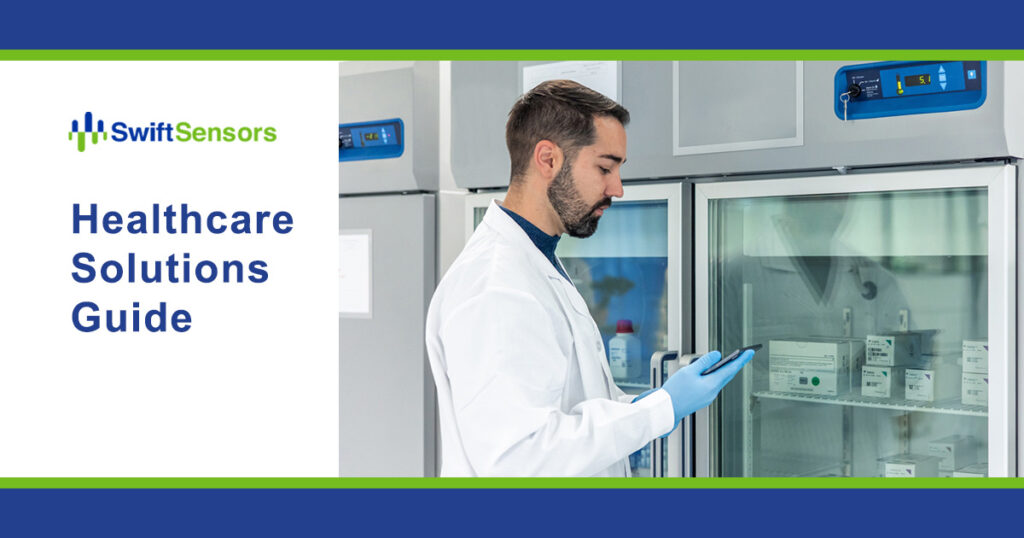
Retail, hospital and compounding pharmacies carry a strict obligation to keep medications, vaccines and compounded preparations inside documented temperature conditions, and the margin for error is thin. A refrigeration failure that goes unnoticed overnight can leave an entire vaccine or medication inventory unusable and expose your pharmacy to state board sanctions. Manual temperature logging takes pharmacist and technician time away from patients, and it leaves gaps in the record that an inspector will find.
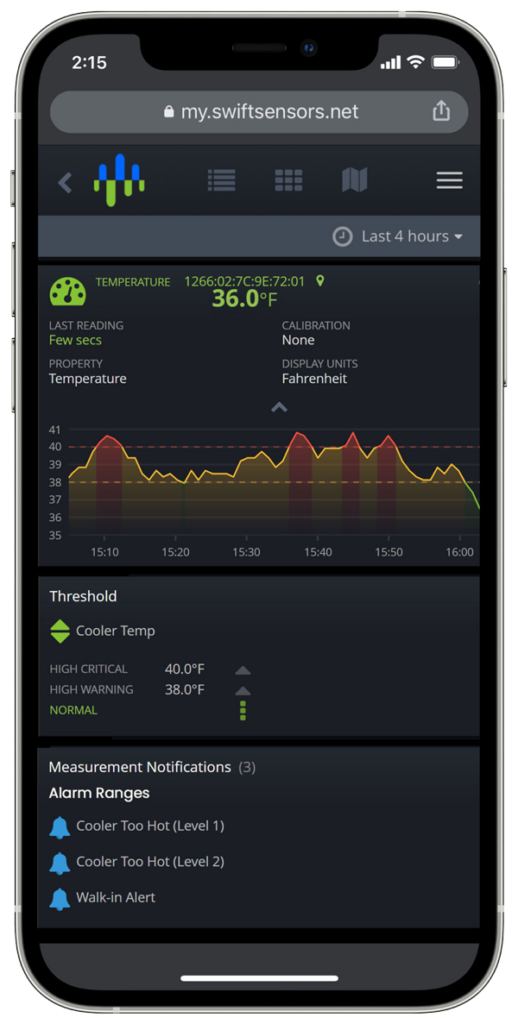
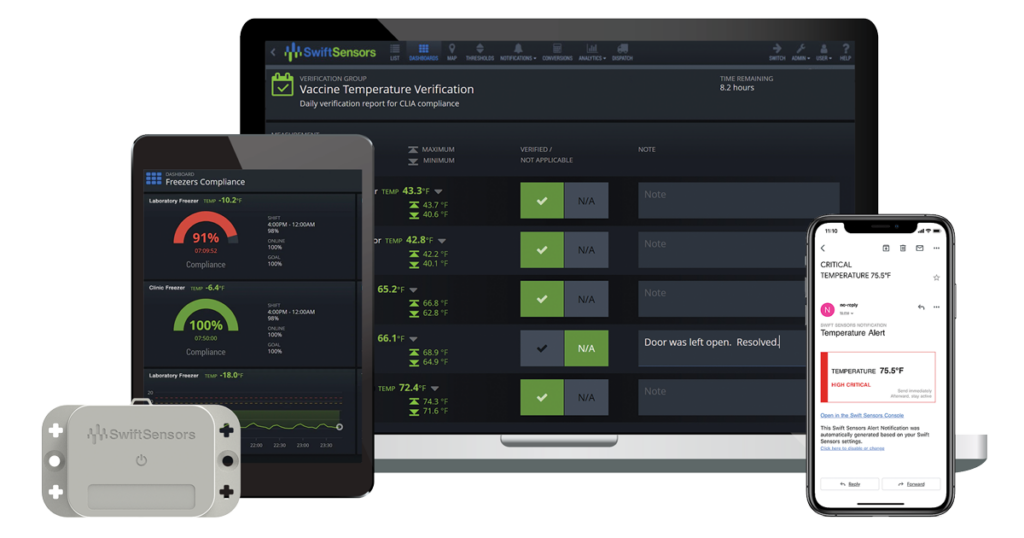
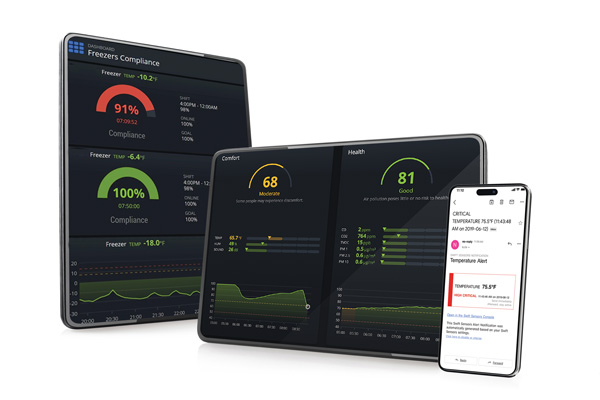
Swift Sensors replaces manual checks with always-on pharmacy temperature monitoring: wireless sensors in every medication refrigerator, freezer and vaccine storage unit send continuous readings to the Swift Sensors Cloud Console. When a unit drifts out of range, instant alerts go out via email, SMS, or phone call, so your staff can act immediately, day or night. The Console keeps a time-stamped record for every unit and produces compliance reports on demand, which helps your team document storage conditions for USP chapters, state health department requirements and CDC vaccine storage guidelines without a clipboard. Easy to deploy, with no wiring and no disruption to daily operations, it is a pharmacy temperature monitoring solution that frees your team from manual logging and keeps the documentation ready when it matters most. View case study.
- Easy-To-Deploy Wireless Sensors
- Instant Critical Mobile Alerts
- Enterprise Cloud Monitoring Software
- Low-Cost Straightforward Monitoring Plan
- Robust Analytics and Compliance Reports
Remote Monitoring
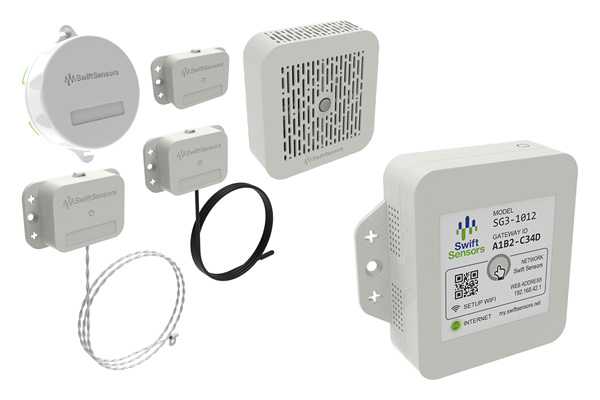
System Components
Protect Your Pharmacy & Your Reputation
Swift Sensors is an easy-to-deploy, scalable monitoring and alerts solution driven by wireless sensors. Send instant alerts via email, SMS, or phone call for events that require immediate corrective action. Protect your business and your reputation from avoidable downtime, loss of assets, and preventable regulatory challenges.
Exceptional Return on Investment
Weiss Medical saved thousands of dollars in medications when Swift Sensors alerted staff of a power failure. View case study.
Example: two refrigerators and a freezer
- $1,610 Year 1: Hardware, NIST Calibration, Monitoring Plan
- $775 Year 2: Annual NIST Calibration, Monitoring Plan
- $775 Year 3: Annual NIST Calibration, Monitoring Plan
Compare to potential expenses:
- Lost vaccines and medications
- Lost irreplaceable patient biosamples
- Lost accreditation and reputation
- Regulatory fines and resubmissions
- Time and labor for manual temperature logging
- Legal fees from lost materials or service disruptions
Temperature Monitoring for Pharmacies
Pharmacy Refrigerators
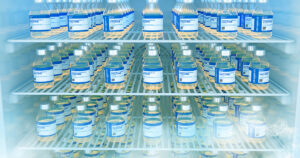
Swift Sensors watches every pharmacy refrigerator around the clock and alerts staff the moment a unit leaves its set range, typically 2°C to 8°C for refrigerated medications.
Medication Freezers
Swift Sensors monitors medication and vaccine freezers continuously, with ultra-low probes available for units that run far colder than a standard freezer.
Vaccine Refrigerators
Continuous readings and instant alerts from Swift Sensors help keep vaccine refrigerators in range and document storage conditions between pharmacy inspections and audits.
Compounding Rooms
Swift Sensors ambient temperature and humidity sensors track cleanrooms, anterooms and storage areas where compounded preparations are made, labeled and held.
USP 797 and USP 800 Temperature Monitoring
Compounding raises the stakes. USP General Chapter <797> sets standards for compounding sterile preparations, including the conditions in the rooms where they are made and the storage conditions for finished preparations. USP General Chapter <800> covers the safe handling of hazardous drugs, from receipt and storage through compounding. Both chapters expect conditions to be controlled, and both expect your records to show it.
Compounding areas
Temperature and relative humidity in the cleanroom suite, including buffer rooms and anterooms.
Storage units
The refrigerators and freezers that hold compounded preparations, components and hazardous drugs.
Receiving and holding areas
Where temperature-sensitive deliveries wait to be put away.
Ambient sensors track room temperature and humidity, probed sensors monitor refrigerators and freezers, and every reading lands in the Swift Sensors Cloud Console as a continuous, time-stamped record. Alerts reach the pharmacist in charge as soon as a room or unit goes out of range, and compliance reports can be downloaded for a board of pharmacy inspection or an accreditation survey. For USP 800, dedicated hazardous drug refrigerators and storage rooms can be monitored and reported on separately, so each has its own record.
Swift Sensors pharmacy temperature monitoring supports your USP compliance program. The program itself, including your standard operating procedures and how your team responds to an excursion, stays with your pharmacy. For a plain-language summary of USP 797, USP 800 and related standards, see the Swift Sensors regulatory compliance overview.
Choosing the Best Pharmacy Temperature Monitoring System
Most temperature monitoring systems for pharmacies look alike on a spec sheet. The differences show up at 2 a.m. on a holiday weekend, and again when an inspector asks for last quarter’s records. When you compare options, these questions separate the best pharmacy temperature monitoring system for your operation from the rest:
Does it alert people, or only record?
A logger that beeps in an empty pharmacy protects nothing. Swift Sensors sends instant alerts via email, SMS, or phone call to individuals or groups, with escalation tiers that reach the next person if no one acknowledges the alert.
Can it tell a door opening from a real excursion?
Thresholds, schedules and alerts are customizable in the Console, and glycol and aluminum thermal buffers keep probe readings from jumping every time a door opens.
Is the record continuous and easy to produce?
The Console stores up to 5 years of time-stamped readings for every unit, lets staff add corrective action notes to an alert or the measurement graph, and downloads compliance reports on demand, including the Daily Extremes report.
Is calibration handled for you?
Swift Sensors offers NIST Calibration through an independent ANAB ISO 17025:2017 accredited laboratory and manages recalibration, annually or on the cycle you set.
Will it keep working through an outage?
Sensors run on batteries with an average life of 6 to 8 years, the optional Mini Backup Power Supply keeps a gateway running for about 12 to 15 hours, and the gateway stores readings while it is offline (as long as it has power) and uploads them when the connection returns.
Will it grow with you?
Each gateway supports up to 150 sensors, so the same system scales from one retail pharmacy to a hospital pharmacy with several rooms and satellite locations.
Best Wireless Sensors For Pharmacies
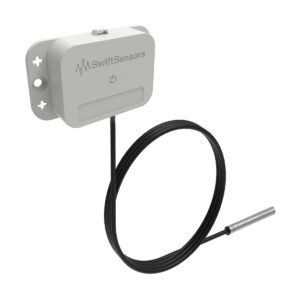
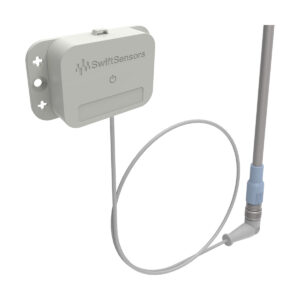
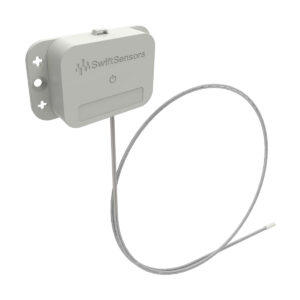
Pharmacy refrigerators and freezers must hold the range each product’s labeling calls for, and the sensor has to be matched to the unit. Swift Sensors pharmacy temperature sensors pair a wireless transmitter with an external probe placed inside the unit, so the condition of every refrigerator and freezer can be monitored remotely. The SS3-105S stainless steel probe measures from -40°C to +125°C with 0.15°C accuracy and fits a thermal buffer for vaccine and medication storage. The SS3-110 reaches down to -100°C for ultra-low freezers, and the SS3-101 tracks ambient temperature and humidity in compounding and storage rooms. Thresholds, schedules, and alerts can be customized in the Swift Sensors Cloud Console to account for door openings and other acceptable activities.
NIST Calibration Services
Swift Sensors offers NIST Calibration services through an independent ANAB ISO 17025: 2017 accredited laboratory. Swift Sensors manages all calibration logistics prior to initial sensor delivery and ensures seamless annual calibration renewal.
Testimonials
FAQ
What temperature should a pharmacy refrigerator be?
Most refrigerated medications and vaccines are stored between 2°C and 8°C (36°F and 46°F), the range the CDC Vaccine Storage and Handling Toolkit uses for refrigerated vaccines. Always follow the storage conditions on each product’s labeling, since some products carry a different range. Frozen vaccines have their own range in the CDC toolkit. Swift Sensors lets you set separate limits for every pharmacy refrigerator and freezer in the Console, so each unit alerts on its own range rather than a single house setting.
How often should pharmacy refrigerator temperatures be checked?
The CDC toolkit asks vaccine providers to check and record minimum and maximum temperatures at the start of each workday, and state boards and accreditors often set their own checking requirements for medication refrigerators. Continuous pharmacy refrigerator temperature monitoring goes further. Swift Sensors records every unit around the clock, alerts staff between checks, and the Daily Extremes report shows each unit’s daily minimum and maximum, the record your team would otherwise write by hand. For vaccines, Swift Sensors adds remote monitoring and alerts alongside the digital data logger your vaccine program requires; it does not replace it. Confirm the checking frequency your own state board and accreditor require.
Where should the temperature probe go in a pharmacy refrigerator?
Place the probe in the center of the unit with the stored product, away from the walls, cooling vents, door and floor, where readings swing the most. CDC guidance calls for a buffered probe in vaccine storage units, and a buffer helps any medication refrigerator avoid false alerts every time the door opens. Swift Sensors offers a glycol thermal buffer bottle and an aluminum thermal buffer for its probed temperature sensors.
What happens to pharmacy temperature monitoring during a power outage?
Swift Sensors wireless sensors run on their own batteries, so they keep measuring when the building loses power. The gateway needs power to pass readings to the cloud. The optional Mini Backup Power Supply keeps it running for about 12 to 15 hours, and a cellular network module covers locations where the internet connection may also go down. While offline, a powered gateway stores readings and uploads them when it reconnects. If a gateway stops reporting altogether, the Console sends an alert (a gateway on backup power keeps reporting, so it does not trigger one). Weiss Medical saved thousands of dollars in medications when Swift Sensors alerted staff of a power failure.
Do pharmacy temperature sensors need calibration?
Yes. Inspectors and accreditors expect the instruments behind your temperature records to be calibrated, and sensors can drift over time. Swift Sensors offers NIST Calibration through an independent ANAB ISO 17025:2017 accredited laboratory, can deliver sensors already calibrated with a certificate, and manages recalibration, annually or on the cycle you set. The Calibration Report in the Swift Sensors Cloud Console shows when each sensor is next due, so no unit falls out of calibration unnoticed.
Can Swift Sensors monitor a compounding room as well as the refrigerators?
Yes. Ambient temperature and humidity sensors such as the SS3-101 monitor cleanrooms, anterooms and storage rooms, and they report to the same Swift Sensors Cloud Console as the refrigerator and freezer probes. Your pharmacy sees every room and every unit in one place, with one set of alerts and one set of compliance reports for USP 797 and USP 800 documentation.
How does the Swift Sensors system work?
A Swift Sensors system requires the purchase of at least one gateway, at least one sensor, and a monitoring plan.
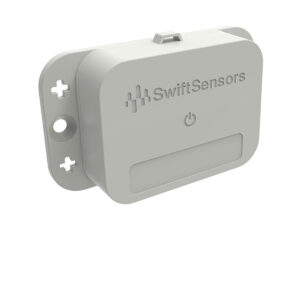
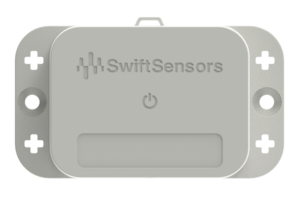
- Swift Sensors wireless sensors measure temperature, humidity, door activity, water leaks and other critical conditions. Each sensor is smaller than a credit card and has battery life of 6-8 years. The sensor transmits data via Bluetooth 5 (BLE5) and connects to the gateway with a push of a button.
- The gateway receives data from each sensor and then transmits the data to the cloud console via local ethernet, WiFi, or cellular network (optional module). Each gateway supports up to 150 sensors within 100 m line of sight (30 m non line of sight).
- The monitoring plan is very simple. The fee is based on the number of sensors you deploy. You can pay monthly, annually, or multi-year. There are no contracts required. View real-time analytics, download compliance reports, and receive instant mobile alerts on any device.
What is the signal range of the sensors?
The sensor range is generally 100 m line of sight and 30 m non line of sight, depending on the facility infrastructure and equipment located between the sensor and the gateway. The SS3-901 and SS3-902 reach 200 m line of sight and 60 m non line of sight. The sensors use the BLE5 wireless communication protocol which allows signal transmission through doors and walls constructed of standard building materials.
What is the battery life of the sensors?
Each sensor uses two AAA lithium polymer batteries with an average lifespan of 6-8 years. Replacement batteries are readily available at hardware stores and various retail locations.
How does the monitoring plan work?
The monitoring plan is very simple. The fee is based on the number of sensors you deploy. You can pay monthly, annually, or multi-year. There are no contracts required.
What is the Swift Sensors Console?
The Swift Sensors Console is a robust cloud-based monitoring, alerts, and reporting platform viewable remotely on any device. The Console is used for hardware setup and system configuration. The Console presents analytics that provide trend analysis, historical documentation, compliance reporting, and deep insights into equipment performance, facility operations, and environmental conditions. The platform is customizable and adaptable to any industry with unparalleled ability to search, filter, sort and view critical measurement and performance data. Configurable instant alerts enable immediate corrective actions when significant events occur. Alerts can be sent to individuals or groups via SMS text, email, or voice.
What about system security?
The Swift Sensors monitoring, alerts, and reporting platform was developed and is maintained by industry experts with extensive experience in network security. Sensor to gateway communication utilizes BLE5 and 128-bit AES encryption. Gateway to cloud Console communication utilizes ethernet, WiFi, or cellular (optional module) and 256-bit AES encryption. Data is securely transmitted over Secure Sockets Layer (SSL) on port 443. The Swift Sensor network does not allow any outside communication. As a result, the Swift Sensor network is incredibly secure.
Can I buy just the sensors?
Swift Sensors only communicate with Swift Sensors gateways. Swift Sensors gateways only communicate with the Swift Sensors Console. The Swift Sensor network does not allow any outside communication. As a result, the Swift Sensor network is incredibly secure. The Swift Sensor Console, however, features a robust API which can be utilized to communicate with 3rd-party applications.
Insights, Innovations
and Installations
Related Monitoring Solutions
See Swift Sensors in Your Pharmacy
Share how many medication refrigerators, freezers and rooms your pharmacy needs to cover. A Swift Sensors specialist will follow up with a quote, a walkthrough of the Cloud Console, or answers to your questions.
- Wireless sensors that install without running wire
- Alerts by email, SMS or phone call, with escalation
- Monitoring plan billed monthly, annually or multi-year, no contracts
- NIST calibration through an ANAB ISO 17025 accredited lab
Prefer to talk? Call 512-256-7552
Ask a Question • Get a Quote • Request a Demo