
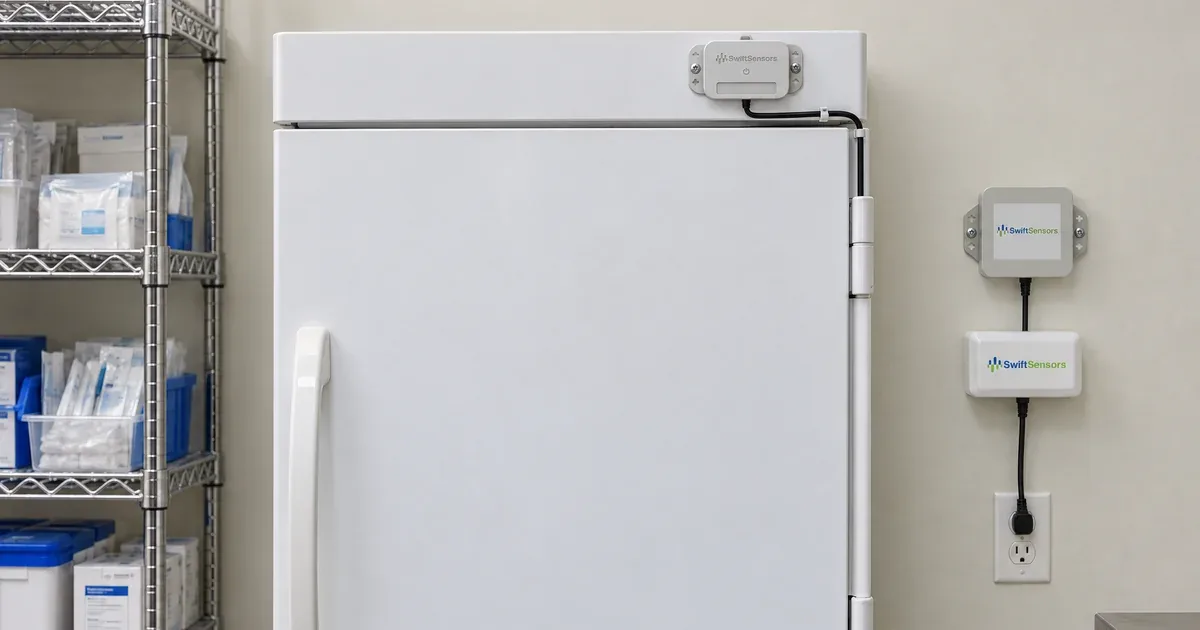
Hospital refrigerator temperature monitoring means reading each unit's temperature on a schedule, logging it, and alerting staff when it leaves the 2 to 8 degrees Celsius range commonly used for refrigerated medications and vaccines. Continuous hospital and clinic monitoring with wireless sensors replaces guesswork with a record you can show an auditor.
By Ray Almgren, President and CEO, Swift Sensors
What Does Hospital Refrigerator Temperature Monitoring Require?
Hospital refrigerator temperature monitoring usually needs four things: sensors that read the real storage temperature, defined ranges with alert thresholds, logs that show what happened, and a person who answers the alarms. Requirements differ by accreditor, state and program, so confirm yours with your pharmacy or quality lead.
Swift Sensors builds wireless sensors and a cloud monitoring service, and temperature monitoring is the core of that work. A contact sensor can alert staff to a power loss at a freezer or compressor, so they can respond before stored medications are put at risk.
What Is the Pharmacy Refrigerator Temperature Range?
The pharmacy refrigerator temperature range for most refrigerated drugs is 2 to 8 degrees Celsius, or 36 to 46 degrees Fahrenheit. That matches the United States Pharmacopeia (USP) definition of a refrigerator and CDC guidance for vaccines held in refrigerated storage.
Two cautions apply. First, follow the label on each product, because some are stored differently. Second, set alert thresholds inside the safe band rather than at its edges, so your team hears about drift before medications are at risk.
If your program requires a digital data logger for vaccines, keep it. Swift Sensors works alongside the digital data logger your program requires, adding remote monitoring on any device, SMS, email and voice alerts, and compliance reports.
What Should a Hospital Fridge Temperature Chart Include?
A hospital fridge temperature chart is the paper or electronic log that shows a unit stayed in range. A usable chart carries these fields:
- Unit ID and location, so two refrigerators or freezers never share a sheet
- Date, time, and the name or initials of the person reading
- The current reading, plus the minimum and maximum since the last check
- The acceptable limits, printed on the chart itself
- The thermometer or sensor ID and its next due date
- A line for out-of-range readings and the action taken
Electronic logs remove the clipboard and make compliance checks faster. The Swift Sensors Cloud Console keeps reading history for up to 5 years, and it records notes on graphs, alert acknowledgements, user-level audit trails, electronic signatures and role-based access.
Which Temperature Sensor Specs Matter for a Hospital Refrigerator?
A spec sheet reads quickly once you know what each line answers. For hospital refrigerators, read these lines in order:
| Spec line | What to check | Why it matters |
|---|---|---|
| Measurement range | Covers 2 to 8 degrees Celsius with room on both sides | Readings near a sensor's limit are less trustworthy |
| Probe type | Air probes or probes in a glycol buffer bottle | Bottle readings follow product temperature, air readings swing with each door opening |
| Calibration | NIST calibration and a certificate on file | Inspectors ask for proof the readings are accurate |
| Batteries and radio | Battery life, replacement steps, wireless range | Dead batteries leave gaps in the logs |
| Reporting interval | How often readings are sent and stored | Short gaps mean temperature excursions are not missed |
| Alert options | Email, SMS, voice call, escalation tiers | Alarms no one hears protect nothing |
Swift Sensors wireless temperature sensors send readings by Bluetooth 5 to a gateway, which forwards them to the cloud by ethernet, WiFi or cellular. Gateway range is 100 m line of sight and 30 m without it. The SS3-105S stainless steel probe sensor fits a glycol buffer bottle.
Swift Sensors NIST calibration comes from an independent ANAB ISO 17025:2017 accredited laboratory, with standard points from minus 50 to plus 150 degrees Celsius for temperature sensors. Swift Sensors alerts you when a gateway or sensor stops reporting, so a silent unit never looks healthy. A silent unit then never looks like a healthy one.
What Is the Pharmacy Freezer Temperature Range in Celsius?
The pharmacy freezer temperature range in Celsius is minus 25 to minus 10 degrees Celsius under the USP definition of a freezer. Some frozen products carry their own labeled ranges, which can differ, so read each insert.
Freezers and other refrigeration equipment fail by power loss as often as by wear. The SS3-603 contact sensor can alert on power loss to a freezer or compressor, and the Mini Backup Power Supply SS-UPS-15-US runs 12 to 15 hours, which buys time for staff to respond.
What Is the Pharmacy Fridge Temperature in Celsius?
The pharmacy fridge temperature in Celsius is 2 to 8 degrees.
Does Medication Stored in Fridge Temperature Need to Stay Between 2 and 8 Degrees Celsius?
For products labeled for refrigeration, yes, unless the manufacturer states another range. A brief excursion does not automatically mean the product is lost, but only the manufacturer or your pharmacist can say, using stability data for that product.
That makes the duration and depth of an excursion the facts that matter, more than any single reading. Continuous logs record how long a unit ran out of range and how far, which gives your pharmacist what they need to decide.
How Often Should Hospital Refrigerator Temperatures Be Checked and Logged?
The answer depends on your accreditor, state rules and program. Many facilities read each unit by hand at least once a day, from its display or a separate thermometer, and record the minimum and maximum. Some programs require more.
Manual checks capture only the moment someone looks. A continuous monitoring system records readings between checks, including nights and weekends, and sends alerts by email, SMS or voice call the moment a unit is out of range.
What Should You Do When a Hospital Refrigerator Goes Out of Range?
Work the same steps every time:
- Confirm the reading against a second, traceable thermometer, then check door seals, power and any local alarms.
- Note when the alert fired and when the unit last read in range.
- Label the contents as on hold. Do not use or discard them yet, and move them to a backup unit if you have one.
- Ask your pharmacist or the manufacturer for stability guidance on each product.
- Record the event, cause and corrective action on the chart, and acknowledge the alert in the Swift Sensors Cloud Console.
- Service the unit and confirm it holds temperature before restocking.
Alert escalation tiers in the Swift Sensors Cloud Console move an unanswered alert to the next person on your list, so a missed call does not become a lost shelf of medications.
Hospital Refrigerator Monitoring: Your Questions Answered
What are the FDA refrigerator temperature guidelines?
FDA food safety guidance says to keep a refrigerator at 40 degrees Fahrenheit or below and a freezer at 0 degrees Fahrenheit. That guidance covers food. Refrigerated medications and vaccines follow their own labels, usually 2 to 8 degrees Celsius (36 to 46 degrees Fahrenheit), so confirm each product's storage ranges with the manufacturer or your pharmacist.
What is the best temperature monitoring device for hospitals?
The best fit is a monitoring system that records readings continuously, sends alerts by email, SMS and voice call, offers NIST calibration through an independent ANAB ISO 17025:2017 accredited laboratory, and provides alert records and reports such as Daily Extremes to support compliance review. Swift Sensors pairs wireless sensors, a gateway and the Swift Sensors Cloud Console to do this. Your pharmacy or quality lead should confirm the choice against your accreditor and program requirements.
Is there a hospital refrigerator temperature monitoring app?
Swift Sensors gives remote monitoring on any device through the Swift Sensors Cloud Console. It shows live readings and sends alerts by email, SMS or voice call when a refrigerator goes out of range. Alert acknowledgements and notes on graphs are recorded, so the response to each alert stays on file.
Where do I find a hospital refrigerator temperature monitoring manual?
Start with the manufacturer's manuals for each refrigerator, freezer and thermometer. Then write your own procedure: who reads each unit, how often, which thresholds trigger a call, and who answers. Keep that procedure with the alert contacts in your monitoring system, next to the sensor and gateway manuals.
See How Pharmacy Refrigeration Monitoring Works
If you want to see what continuous readings, instant alerts and a 5-year record look like for your own units, read how pharmacy refrigeration monitoring works with wireless sensors, a gateway and the Swift Sensors Cloud Console.

