
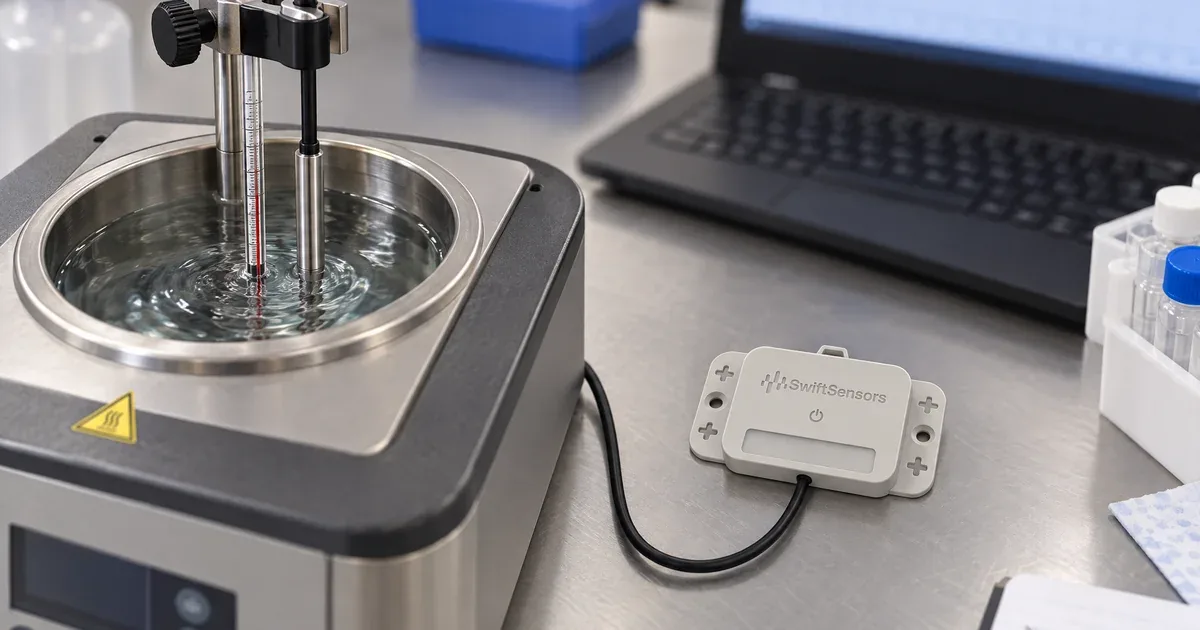
How often should temperature probes be calibrated? A common starting point is once a year, shortened for critical, harsh or heavily used applications. Swift Sensors pairs wireless temperature sensors with NIST calibration through an independent ANAB ISO 17025:2017 accredited laboratory, so your readings stay traceable when an auditor asks.
By Ray Almgren, President and CEO, Swift Sensors
How Often Should Temperature Probes Be Calibrated?
Many manufacturers and quality programs treat once a year as the baseline for temperature probes. A probe that guards product quality, food safety or regulatory compliance usually earns a shorter interval. A probe in a low-risk space can sometimes run longer.
Calibration compares a probe against a traceable reference and documents or corrects the error. Calibration intervals are the planned gaps between those comparisons. Accurate temperature measurement depends on them: every probe drifts, meaning its readings slowly move away from the true value, so regular calibration catches that movement before it costs you product. Annual is the most common baseline, but it is a starting point, not a rule. Your manufacturer, your auditor and your own history set the final calibration frequency.
How Often Should a Temperature Sensor Be Calibrated?
The same logic applies. A temperature sensor is the probe plus its electronics, and the sensing element inside is what drifts. Plan an annual baseline, then shorten it when the stakes or the stress rise. Swift Sensors offers calibration onsite or remotely through an independent ANAB ISO 17025:2017 accredited laboratory, and the calibration report documents the result.
What Determines Sensor Calibration Frequency for Wireless Temperature Probes?
Five factors move calibration intervals. Weigh each one for the specific probe, not the facility as a whole.
| Factor | Pushes the interval shorter | Allows a longer interval |
|---|---|---|
| Cost of a wrong reading | Medications, lab samples, high-risk food | Low-value stock with wide tolerance |
| Environmental conditions | Freeze-thaw cycles, moisture, heat, washdown | Stable, dry spaces |
| Handling and vibration | Drops, knocks, compressor vibration | Fixed mounting, little movement |
| Calibration history | Past results close to the tolerance limit | Several results well inside tolerance |
| Outside requirements | Manufacturer, auditor or health department asks for tighter schedules | Requirement allows a documented, justified interval |
How Does Calibration Frequency Differ for Wireless and Wired Temperature Probes?
Mostly it does not. The wireless link carries the reading; it does not change the measurement. A wired setup may need the probe and its reader calibrated as a pair. With wireless temperature sensors, the sensor itself is the unit under test. Swift Sensors sends readings by Bluetooth 5 to a gateway, which passes them to the cloud, and reading history stays available in the Swift Sensors Cloud Console for up to 5 years.
Do Wireless Temperature Sensors Drift Faster Than Wired Ones?
No. The connection type does not cause drift. Aging of the sensing element and physical stress do.
Can You Lengthen the Calibration Frequency If a Probe Stays Within Tolerance?
Often yes, with documentation. Many quality programs lengthen calibration intervals after several consecutive calibrations find a probe well inside tolerance, for example from six months to twelve. Record the reasoning, and get your auditor comfortable with it first. Keep the shorter interval for can't-fail assets, where bad measurements cost more than an extra visit. If a longer interval ever produces an out-of-tolerance result, go back to the shorter one.
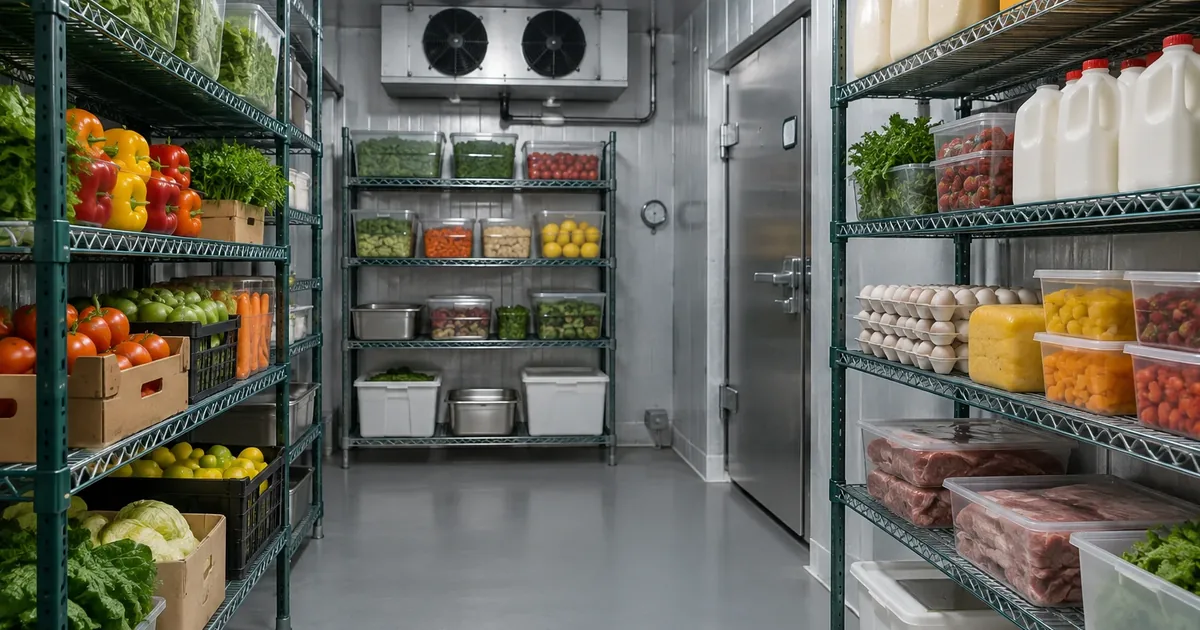
What Calibration Frequency Do Food Safety, Pharmaceutical and Lab Standards Require?
No standard sets one number for every probe. Each sets a principle, and the manufacturer, auditor or health department fills in the calibration frequency.
| Application | What the guidance expects | Source |
|---|---|---|
| Food service | Food thermometers stay accurate and are calibrated as necessary under the manufacturer's specifications; routine checks are set locally | FDA Food Code, adopted by local health departments |
| Pharmaceutical manufacturing | Instruments calibrated at suitable intervals under a written program | 21 CFR Part 211 |
| Vaccine storage | A digital data logger with a current calibration certificate, often renewed every one to two years or on the manufacturer's schedule | CDC storage and handling guidance |
| Accredited and testing labs | Interval set and justified by the lab from risk and history | ISO/IEC 17025 and ILAC G24 |
For pharmaceuticals, a calibration certificate from an accredited calibration provider is the record most auditors ask to see. Teams storing pharmaceuticals can pair calibrated probes with pharmaceutical monitoring that records continuous readings and sends instant alerts via email, SMS or phone call when a value goes out of range. Swift Sensors works alongside the digital data logger your program requires and adds compliance reports. Monitoring supports regulatory compliance; it does not replace the standard.
How Do You Know a Temperature Probe Needs Calibration Sooner Than Scheduled?
Do not wait for the calendar when any of these happens:
- The probe was dropped, knocked or soaked.
- It was exposed to temperatures outside its rated range.
- Its temperature readings differ from a calibrated thermometer, or from a second sensor in the same unit, by more than your tolerance.
- The trend graph shows a steady offset or a sudden step that the equipment does not explain.
- An audit or inspection questioned its accuracy.
In the Swift Sensors Cloud Console, trend graphs and notes on graphs make a gradual offset visible and keep the explanation with the data.
What Happens If a Temperature Probe Is Out of Calibration?
A probe reading 2 °C warm triggers false alarms and needless product discards. A probe reading 2 °C cool is worse. It can hide a real temperature excursion while product sits out of range, and temperature excursions can compromise the safety and efficacy of temperature-sensitive inventory. Under regulated programs, teams usually review product handled since the last good calibration and document corrective action.
How Do You Calibrate a Wireless Temperature Probe?
Calibrate temperature sensors in two layers: quick verification checks in-house, and accredited calibration for records that must hold up.
- Pick a reference. Use a calibrated thermometer whose calibration certificate is traceable to NIST.
- Run an ice-point check. Fill an insulated container with crushed ice, add clean water until it forms a slush, and stir. Hold the probe in the middle, away from the sides, until the dial or display settles. The result should sit near 0 °C (32 °F), within the tolerance your program allows.
- Record the result. Log the date, the reference, the reading and the difference.
- Act on a miss. Follow the manufacturer's instructions for adjustments. A dial thermometer usually has a nut under the dial for small adjustments, and digital instruments use offset settings. Otherwise, arrange recalibration.
- Schedule accredited calibration. Swift Sensors offers NIST calibration through an independent ANAB ISO 17025:2017 accredited laboratory, with standard points from minus 50 °C to plus 150 °C for temperature sensors. A minus 80 °C point is available through another accredited laboratory, so ultra-low probes can be calibrated at the temperature they actually run.
An ice bath checks one point. A freezer probe working at minus 20 °C can be off there even when it reads 0 °C correctly, so ice-point checks support accredited calibration but do not replace it. Keep the calibration report with your other calibration records.
What Is the Difference Between a Calibration and a Verification Check?
Verification compares a probe to a reference and records the difference, with no change to the probe. Calibration compares it against a traceable reference at defined points, documents the error and, where the manufacturer allows, corrects it through adjustments. It ends with a calibration certificate. You need both: verification catches trouble early, and scheduled calibrations give auditors the paper trail.
Common Questions About Temperature Probe Calibration
Do temperature probes need to be calibrated?
Yes. Every probe drifts over time, and heat, moisture, shock and vibration speed that up. Calibration confirms accuracy against a traceable reference and gives you a calibration certificate to show an auditor, protecting product quality and compliance.
How often must thermometers be calibrated?
No single rule covers every thermometer. Manufacturers state recommended calibration intervals, health departments and quality systems add their own, and a common baseline is once a year. Critical thermometers, such as those guarding pharmaceuticals or held food, often get shorter intervals. Follow the strictest requirement that applies.
How often should temperature probes be calibrated in food service?
The FDA Food Code, which local health departments adopt in their own versions, expects food thermometers to stay accurate and be calibrated as necessary under the manufacturer's specifications. A practical routine for thermometer calibration is to check handheld probes at the start of a shift and after any drop, and to schedule accredited calibration for fixed sensors.
When should thermometers be calibrated in ServSafe?
Food safety courses such as ServSafe generally point to the same triggers for thermometer calibration: when a thermometer is new, after it is dropped, after a swing between extreme temperatures, and on a routine schedule. Confirm the exact schedule with your local health department.
Set Your Probe Calibration Schedule With Swift Sensors
Swift Sensors offers NIST calibration through an independent ANAB ISO 17025:2017 accredited laboratory, onsite or remotely, which helps support the calibration intervals you set for your program. Review the calibration services to see what fits your schedule.

