
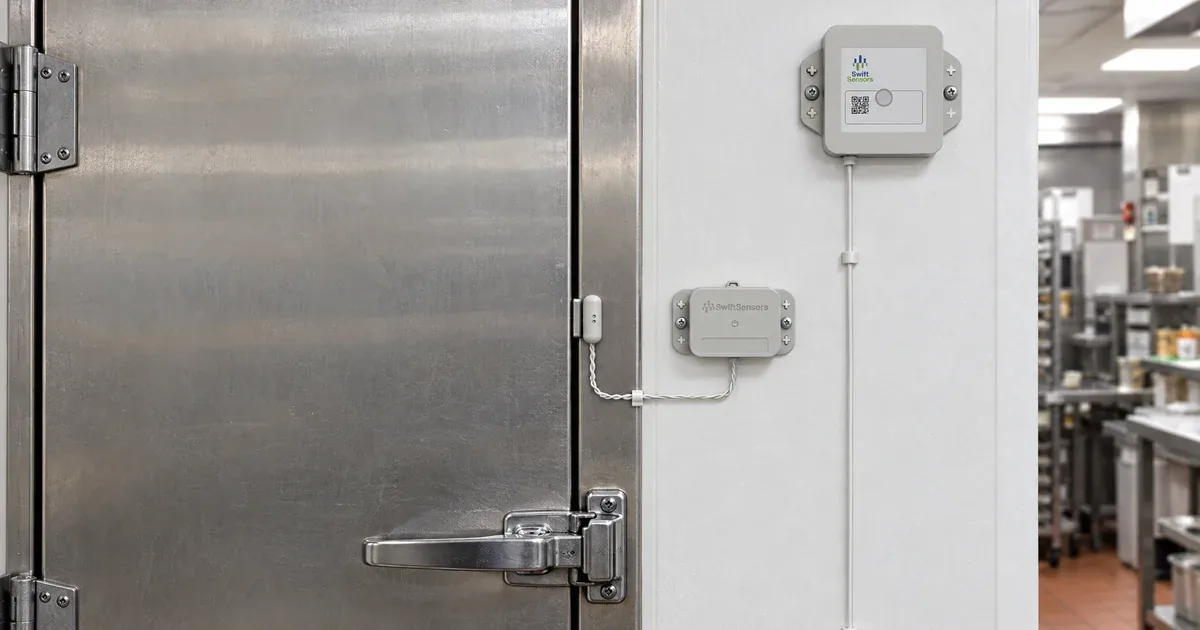
Restaurant refrigeration monitoring uses wireless temperature sensors inside walk-in coolers, freezers and reach-in refrigerators to log temperatures around the clock and send instant alerts via email, SMS or phone call when a unit runs out of range. For a dozen locations, it replaces clipboard checks with one record.
By Ray Almgren, President and CEO, Swift Sensors
What This Article Covers
- What Is Restaurant Refrigeration Monitoring and How Does It Work?
- Why Do Multi-Location Restaurants Need Refrigeration Monitoring?
- How Do You Plan a Restaurant Refrigeration Monitoring Rollout Across a Dozen Locations?
- What Equipment and Sensors Do You Need to Monitor Walk-In Coolers and Freezers?
- What Temperature Should a Restaurant Walk-In Cooler and Freezer Be Kept At?
- How Do You Set Temperature Alerts and Escalation Rules for Restaurant Coolers?
- How Much Does Restaurant Refrigeration Monitoring Cost and How Do You Measure Its Return?
- Does Wireless Temperature Monitoring Help With HACCP and Health Inspections?
- Questions People Ask About Restaurant Fridge Temperatures
- Scope Monitoring for All Your Restaurant Locations
What Is Restaurant Refrigeration Monitoring and How Does It Work?
A walk-in cooler can drift above safe temperatures overnight and look normal at opening, with spoiled inventory as the only evidence. Restaurant refrigeration monitoring closes that gap. Wireless sensors measure temperature inside each unit and pass readings by Bluetooth 5 to a gateway. The gateway sends them to the cloud over ethernet, WiFi or cellular. You see live readings in the Swift Sensors Cloud Console, and the system sends alerts when a unit goes out of range.
Commercial refrigeration monitoring systems share four parts:
- Wireless sensors read temperature in coolers, freezers and refrigerators. Bluetooth 5 needs no IP address per sensor and extends battery life.
- A gateway uploads sensor readings. If it loses its connection but keeps power, it stores readings and uploads them on reconnection.
- The Swift Sensors Cloud Console shows live values, trend graphs and alert history.
- A monitoring plan, which every system needs alongside at least one gateway and one sensor.
What Is the Best Way to Monitor Restaurant Refrigerator Temperatures Remotely?
What is remote temperature monitoring in practice? It is sensors that report readings to the cloud so you can check and act on every unit without being on site. Continuous wireless sensors work best because they cover every unit when nobody is in the building. A manager opens the Swift Sensors Cloud Console on any device and receives alerts by email, SMS or phone call. The same monitoring system scales from one reach-in to a full chain.
Why Do Multi-Location Restaurants Need Refrigeration Monitoring?
One failed walk-in can cost a full delivery of inventory, which is why walk-in cooler temperature monitoring is usually the first priority. Across twelve locations, some unit is likely to struggle on any given night. Multi location temperature monitoring lets one team watch every store's units from a single console instead of waiting for a call from each site. Continuous monitoring helps surface problems early:
- A walk-in door left ajar after a delivery
- A worn gasket letting warm air into a reach-in
- A compressor that needs longer to hold the same temperature, visible on the trend graph
- A power outage that stops refrigeration and starts spoilage
Swift Sensors' refrigeration monitoring also builds the paper trail. Automatic temperature logs support food safety audits and regulatory compliance, and they free managers from clipboard rounds, one of the simplest operational efficiencies across a chain.
How Do You Plan a Restaurant Refrigeration Monitoring Rollout Across a Dozen Locations?
A restaurant refrigeration monitoring rollout starts with decisions, not hardware. Count the units, set one standard, then install in waves with one owner per phase. Multi site temperature monitoring works best when every store follows the same naming and threshold rules.
| Phase | What happens | Owner |
|---|---|---|
| Audit | List every walk-in, freezer, reach-in and prep refrigerator at each location, and flag dry storage that needs humidity readings | Operations |
| Standard | Fix sensor names, thresholds and alert recipients | Operations and food safety lead |
| Pilot | Install at one or two locations and test alerts overnight | Regional manager |
| Waves | Install three or four locations at a time with a site walkthrough | Regional and site managers |
| Review | Compare alerts and logs, then tune thresholds | Operations |
How Long Does It Take to Roll Out Temperature Monitoring Across Multiple Restaurants?
Wireless installation needs no wiring, so one location often takes hours rather than days. Many teams plan a pilot week, then waves every week or two, putting a dozen locations inside roughly one to two months.
What Equipment and Sensors Do You Need to Monitor Walk-In Coolers and Freezers?
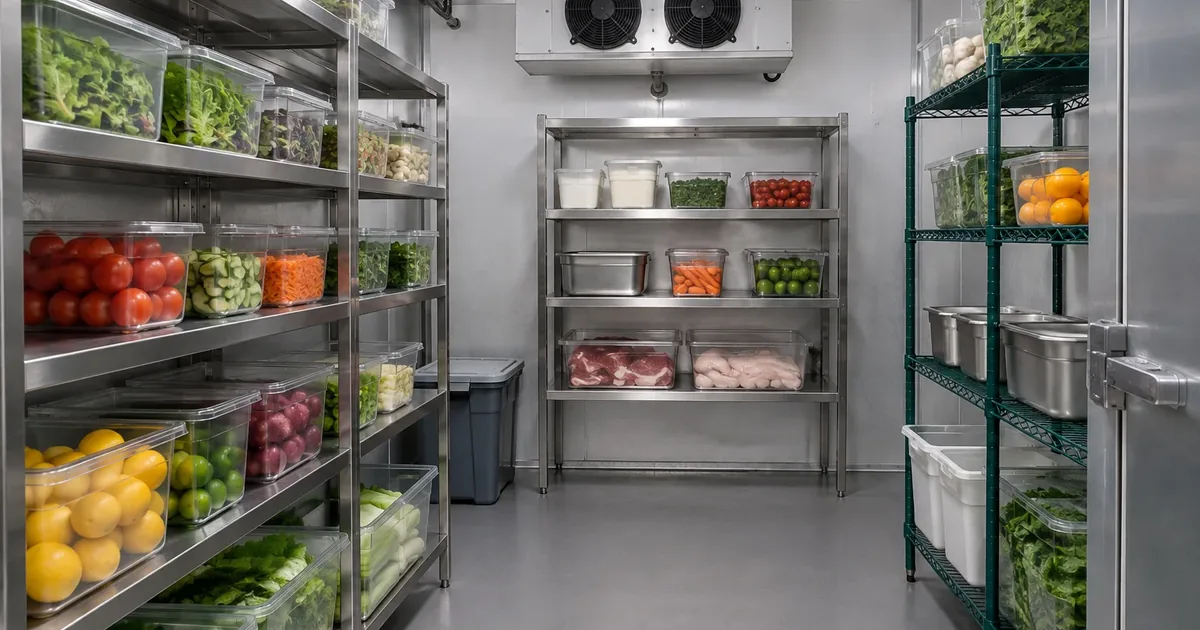
Each location needs at least one gateway, one sensor per monitored unit and a monitoring plan. Beyond that, choose a sensor that fits each risk:
- Temperature sensors for every walk-in cooler, walk-in freezer, reach-in and prep refrigerator.
- Humidity sensors for dry storage and produce rooms, where moisture affects shelf life.
- A contact sensor that alerts on power loss to a freezer or compressor.
- A Mini Backup Power Supply that keeps the gateway running 12 to 15 hours through an outage.
A gateway reaches 100 meters with line of sight and 30 meters without it. Metal-clad walk-in walls can weaken a radio signal, so place the gateway near the kitchen and confirm signal first.
How Do You Install and Configure Refrigeration Sensors at Each Restaurant Location?
Installation is wireless, so follow the same five steps at every site:
- Plug in the gateway near the kitchen and connect it by ethernet, WiFi or cellular.
- Mount each sensor where air circulates, away from the door opening and direct fan blast.
- Name each sensor by store and unit, such as Store 07 Walk-In Freezer.
- Enter your thresholds in the Swift Sensors Cloud Console.
- Check each reading against your own reference thermometer, then trigger one test alert before you leave.
What Temperature Should a Restaurant Walk-In Cooler and Freezer Be Kept At?
The FDA Food Code sets cold holding at 41°F (5°C) or below for food that needs temperature control for safety, and USDA recommends 0°F (minus 18°C) for frozen food. Your state or local code may differ, so confirm limits with your health department.
| Unit | Common target | Note |
|---|---|---|
| Walk-in cooler | 41°F (5°C) or below | Set alarms a few degrees inside the limit |
| Reach-in and prep refrigerators | 41°F (5°C) or below | Doors open often, so recovery time matters |
| Walk-in freezer | 0°F (minus 18°C) or below | USDA recommendation for frozen food |
How Often Should Restaurants Check Refrigerator and Freezer Temperatures?
Your HACCP plan and local health department set the check frequency, not one national number. Many kitchens log temperatures at opening and closing at minimum, and some check every four hours. Continuous sensors fill the gaps between rounds.
How Do You Set Temperature Alerts and Escalation Rules for Restaurant Coolers?
Set a high and a low limit for each unit, with enough margin that a brief door opening does not trigger an alert. Then set escalation tiers in the Swift Sensors Cloud Console so alarms reach the right person:
- Tier one: the shift lead gets an SMS.
- Tier two: if no one acknowledges the alert in your set time, the general manager gets a phone call.
- Tier three: the regional manager gets a phone call.
The Swift Sensors Cloud Console also alerts when a gateway or sensor stops reporting, so dead batteries or a lost connection do not pass for a quiet night. Notes on graphs and alert acknowledgements record the corrective action, such as moving product to another cooler.
How Much Does Restaurant Refrigeration Monitoring Cost and How Do You Measure Its Return?
Restaurant refrigeration monitoring cost follows system size: the number of gateways, sensors and the monitoring plan you need. Count units first, then ask Swift Sensors to scope a monitoring plan that fits. Judge return against a baseline recorded before rollout:
- Spoilage write-offs from refrigeration failures, per location
- Manager hours spent on manual rounds and temperature logs
- Time to pull records for an audit or inspection
- Alerts that led to corrective action before product was lost
Compare 90 days before and after, location by location.
Does Wireless Temperature Monitoring Help With HACCP and Health Inspections?
Yes, as a support for both. HACCP (Hazard Analysis and Critical Control Points) is the food safety system that treats cold holding as a control point and requires records and a corrective action when a limit is missed.
Swift Sensors monitors each unit continuously, and the Swift Sensors Cloud Console keeps temperature logs for up to 5 years, with user-level audit trails, electronic signatures and role-based access. Swift Sensors provides NIST calibration through an independent ANAB ISO 17025:2017 accredited laboratory, and a Calibration Report is available. Monitoring supports regulatory compliance. It does not replace your HACCP plan.
Questions People Ask About Restaurant Fridge Temperatures
How often should the temperature of the refrigerator be monitored?
Continuously is the most reliable answer, because a unit can leave range between manual checks. Your HACCP plan and local health department set the minimum for manual logs.
How to monitor fridge temperature remotely?
Place a wireless sensor in each unit and connect it to a gateway over Bluetooth 5. The gateway uploads readings to the Swift Sensors Cloud Console through ethernet, WiFi or cellular, where you view live temperature from any device and receive alerts by email, SMS or phone call.
How cold should a restaurant refrigerator be?
The FDA Food Code sets 41°F (5°C) or below for cold holding of food that needs temperature control for safety. Freezers are commonly held at 0°F (minus 18°C) or below. Confirm the limits your state or local health department enforces.
What is an unsafe temperature for a refrigerator?
Above 41°F (5°C) is out of range for cold-held food under the FDA Food Code. Follow your HACCP plan for affected inventory.
Scope Monitoring for All Your Restaurant Locations
Start by counting the walk-in coolers, freezers and refrigerators at each location, then see how Swift Sensors approaches restaurant temperature monitoring across a multi-unit chain.

