Restaurant Temperature Monitoring and Food Safety

Application Temperature iPhone

Let's Get Started

Ask a Question • Get a Quote • Request a Demo
Contact Us

Restaurant Temperature Monitoring, Alerts, and Compliance Reports

A walk-in cooler that fails overnight or over a holiday weekend can destroy a week of prep, force a menu shutdown at the worst possible moment, and become a health inspection finding before anyone on your team knows there is a problem. Restaurant temperature monitoring closes that gap. Most kitchens still depend on manual temperature checks that get skipped or rushed during a busy service, which leaves refrigerated inventory, and your guests, exposed between log entries.

Swift Sensors wireless temperature sensors install without wiring or disruption to kitchen operations and monitor every walk-in cooler, reach-in refrigerator, prep table, and freezer around the clock. The moment a reading goes out of range, instant alerts reach your phone by SMS, email, or phone call, so your team can move product and call for service before inventory is lost or a food safety risk develops. Every reading is stored in the Swift Sensors Cloud Console, which turns continuous data into temperature logs and compliance reports you can pull up when a health inspector asks, instead of scrambling for handwritten records. The result is a restaurant temperature monitoring system that supports your HACCP plan and your health code obligations without adding another task to an already stretched team. View case study.

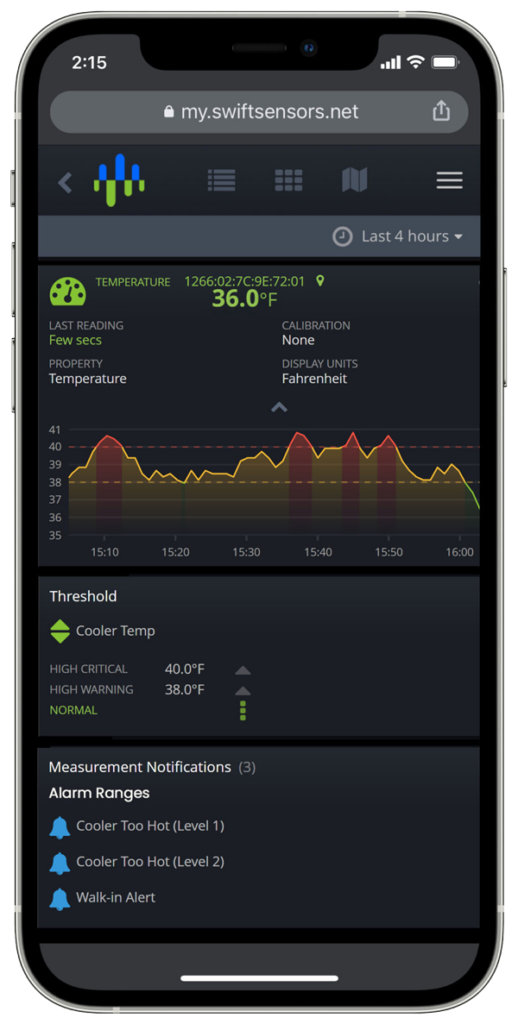
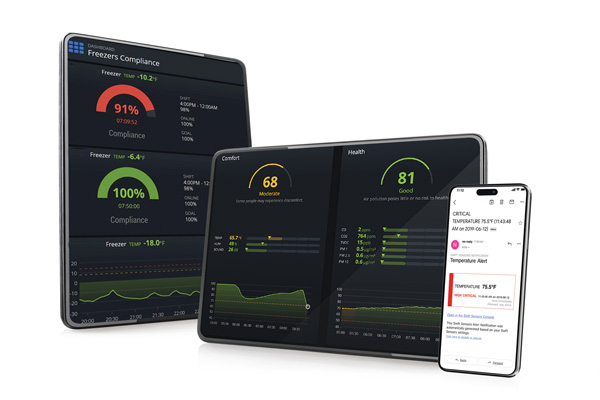
View commercial refrigeration temperature data on any device in real time.

Food Service Flyer

Food Service Guide

Protect Your Business & Your Reputation​

Swift Sensors is an easy-to-deploy, scalable monitoring and alerts solution driven by wireless sensors. Send instant alerts via email, SMS, or phone call for events that require immediate corrective action. Protect your business and your reputation from avoidable downtime, loss of assets, and preventable regulatory challenges.

Exceptional Return on Investment

Cole Hospitality Protects Inventory and Customers with Food Safety Monitoring

Bryce Cole, the owner of Cole Hospitality, knew he had a lot riding on his refrigeration and freezer units spread across the six restaurants he operates. View case study.

Example: two refrigerators and a freezer

Compare to potential expenses:

Temperature Monitoring for Restaurants

Best Wireless Sensors For Restaurants

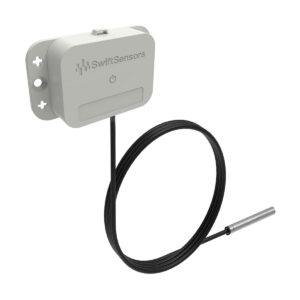
Commercial refrigerators and freezers keep food at safe, precise temperatures only as long as the equipment keeps up. Swift Sensors temperature sensors with a stainless steel probe, such as the SS3-105-10 with its 10 m (30 ft) probe, are most commonly used in walk-in coolers, commercial refrigerators, and freezers, and measure from -40°F to +257°F. Thresholds, schedules, and alerts can be customized in the Swift Sensors Cloud Console to account for door openings and other expected activity, so an alert means something. Door sensors log every time a cooler is opened or left open, and water detection puck sensors watch for leaks beside ice machines and other water-using equipment. Each sensor is IP66 rated or better, dust proof and water resistant.

Food Safety and HACCP Temperature Monitoring

Food safety comes down to time and temperature. The FDA Food Code, which most state and local health departments adopt in some form, sets cold holding for time/temperature control for safety (TCS) foods at 41°F (5°C) or below. A cooler that drifts above that line overnight can put a full walk-in of product in question by morning, and nobody finds out until the first shift opens the door.

HACCP plans treat temperature as a critical control point: define the critical limit, monitor it, take corrective action when it is exceeded, and keep records that show it was done. Food safety temperature monitoring with wireless sensors fits that structure closely:

Critical limits become alert thresholds

Each cooler, freezer, and reach-in gets its own threshold and schedule in the Swift Sensors Cloud Console.

Monitoring is continuous

Probe sensors report as often as every minute (every 5 minutes by default), including the hours when nobody is in the kitchen.

Restaurant Temperature Monitoring with Wireless Sensors

Corrective action starts sooner

Instant alerts by SMS, email, or phone call go to individuals or groups, and escalate to the next person if the first does not respond, so someone hears about a temperature excursion while there is still time to save product.

Corrective actions are documented

Staff can record what they did as a note in the alert history, on the alert acknowledgement, or directly on the measurement graph.

Records build themselves

Every reading is timestamped and stored, the Daily Extremes report shows each unit's minimum and maximum for the day, and compliance reports can be downloaded on any device for a manager review or an inspection.

HACCP temperature monitoring with Swift Sensors supports your food safety plan and simplifies the documentation behind it. It does not replace the plan, the staff training behind it, or the checks your health department requires. For kitchens that want traceable accuracy, Swift Sensors offers NIST Calibration services through an independent ANAB ISO 17025:2017 accredited laboratory and manages the renewal.

Choosing a Restaurant Temperature Monitoring System

Food temperature monitoring systems range from a thermometer and a clipboard to connected platforms that watch every unit and send alerts. For a restaurant, a few questions separate the two:

01

Does it alert in real time?

A logger that is read the next morning documents a loss. A wireless system that alerts during the night gives your team a chance to prevent one.

02

Does it fit the kitchen?

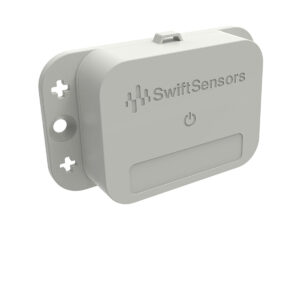
Swift Sensors sensors are smaller than a credit card, run 6 to 8 years on average on their batteries, and connect to the gateway with the push of a button. No wiring, no downtime.

03

Does it handle a busy service?

Customizable thresholds and schedules keep routine door openings from turning into a stream of needless alerts.

04

Does it cover more than temperature?

A complete restaurant monitoring system can add door sensors, water leak detection, and humidity monitoring on the same gateway and the same Cloud Console.

05

Does it stay connected?

The gateway reaches the cloud over ethernet, WiFi, or an optional cellular module. If the internet connection drops, the gateway stores readings as long as it has power and uploads them when the connection returns, and the optional Mini Backup Power Supply keeps the gateway running for approximately 12 to 15 hours through a power outage.

06

Is the cost predictable?

A Swift Sensors system is at least one gateway, at least one sensor, and a monitoring plan priced by the number of sensors, with no contracts required.

Grows one unit at a time

Whether you run a single cafe or a larger food service operation, the same food service temperature monitoring system grows one unit at a time. Restaurant refrigeration monitoring is where most kitchens start, and the system can expand from there as your needs change.

The Austin Country Club

Testimonials

FAQ

The FDA Food Code sets cold holding for TCS foods at 41°F (5°C) or below, and your state or local health department’s adopted code has the final word. A common practice is to set the walk-in alert threshold a few degrees below 41°F, so there is time to act before product is at risk. In the Swift Sensors Cloud Console you can set a separate threshold and alert schedule for every walk-in cooler, reach-in, and freezer.

The readings record themselves. Swift Sensors probe sensors report as often as every minute, and every reading is stored in the Cloud Console with a timestamp, so temperature logs, the Daily Extremes report and compliance reports can be downloaded instead of written by hand. Whether an electronic record fully replaces a paper log is set by your health department and your HACCP plan, so confirm what your inspector expects before you retire the clipboard.

They do not have to. Thresholds, schedules, and alerts can be customized in the Swift Sensors Cloud Console to account for temporary events such as the opening and closing of doors. A door sensor on the walk-in also logs every open and close, so when a temperature alert does fire, your team can see right away whether the door was left open.

A typical starting point is one temperature sensor per cold unit: a stainless steel probe sensor (the SS3-105S, SS3-105-10 or SS3-105-15, the same sensor in three probe lengths) for walk-in coolers, reach-ins, and freezers, plus an ambient temperature and humidity sensor (SS3-101) for dry storage. Door sensors (SS3-301) and water detection puck sensors (SS3-108P) are common additions. Every sensor reports to a gateway that supports up to 150 sensors, and one monitoring plan covers them all.

The sensors run on their own batteries, so they keep measuring when the building loses power, and a rising cooler temperature is exactly what they are there to catch. The gateway needs power to pass readings to the cloud. The optional Swift Sensors Mini Backup Power Supply keeps a gateway running for approximately 12 to 15 hours through an outage, so alerts can still reach your phone while the walk-in warms. Without the backup supply, the Swift Sensors Cloud Console alerts your team when the gateway stops reporting, so an outage does not go unnoticed.

A Swift Sensors system requires the purchase of at least one gateway, at least one sensor, and a monitoring plan.

  • Swift Sensors wireless sensors measure temperature, humidity, door activity, water leaks and other critical conditions. Each sensor is smaller than a credit card and has battery life of 6-8 years. The sensor transmits data via Bluetooth 5 (BLE5) and connects to the gateway with a push of a button.
  • The gateway receives data from each sensor and then transmits the data to the cloud console via local ethernet, WiFi, or cellular network (optional module). Each gateway supports up to 150 sensors within 100 m line of sight (30 m non line of sight).
  • The monitoring plan is very simple. The fee is based on the number of sensors you deploy. You can pay monthly, annually, or multi-year. There are no contracts required. View real-time analytics, download compliance reports, and receive instant mobile alerts on any device.
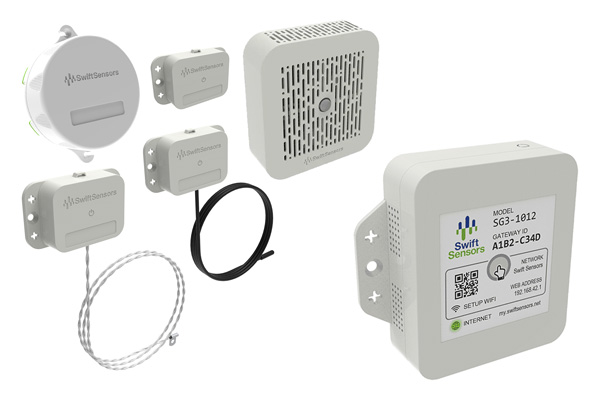
The sensor range is up to 100 m line of sight and 30 m non line of sight, depending on the facility infrastructure and equipment located between the sensor and the gateway. The sensors use the BLE5 wireless communication protocol which allows signal transmission through doors and walls constructed of standard building materials.

Each sensor uses two AAA lithium polymer batteries with an average lifespan of 6-8 years.  Replacement batteries are readily available at hardware stores and various retail locations.

The monitoring plan is very simple. The fee is based on the number of sensors you deploy. You can pay monthly, annually, or multi-year. There are no contracts required.

The Swift Sensors Console is a robust cloud-based monitoring, alerts, and reporting platform viewable remotely on any device. The Console is used for hardware setup and system configuration. The Console presents analytics that provide trend analysis, historical documentation, compliance reporting, and deep insights into equipment performance, facility operations, and environmental conditions. The platform is customizable and adaptable to any industry with unparalleled ability to search, filter, sort and view critical measurement and performance data. Configurable instant alerts enable immediate corrective actions when significant events occur. Alerts can be sent to individuals or groups via SMS text, email, or voice.

The Swift Sensors monitoring, alerts, and reporting platform was developed and is maintained by industry experts with extensive experience in network security. Sensor to gateway communication utilizes BLE5 and 128-bit AES encryption. Gateway to cloud Console communication utilizes ethernet, WiFi, or cellular (optional module) and 256-bit AES encryption. Data is securely transmitted over Secure Sockets Layer (SSL) on port 443. The Swift Sensor network does not allow any outside communication. As a result, the Swift Sensor network is incredibly secure.

Swift Sensors only communicate with Swift Sensors gateways. Swift Sensors gateways only communicate with the Swift Sensors Console. The Swift Sensor network does not allow any outside communication. As a result, the Swift Sensor network is incredibly secure. The Swift Sensor Console, however, features a robust API which can be utilized to communicate with 3rd-party applications.

Get a quote or a demo

See Swift Sensors in Your Kitchen

Share how many walk-in coolers, reach-ins and freezers you need to cover. A Swift Sensors specialist will follow up with a quote, a walkthrough of the Cloud Console, or answers to your questions.

  Prefer to talk? Call 512-256-7552

Ask a Question • Get a Quote • Request a Demo

Contact Us