
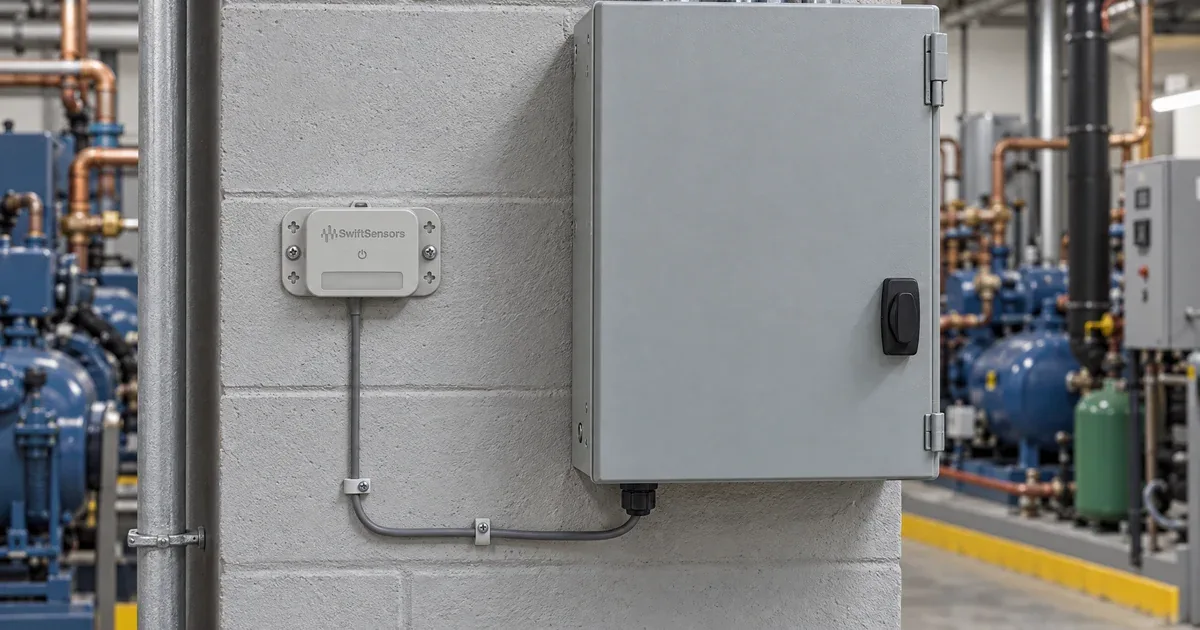
Refrigeration failure in a food plant often starts as small drift, not a sudden stop: slower recovery after door openings, wider swings, a warmer average. Continuous refrigeration monitoring turns that drift into trend graphs and threshold alerts, so your team can act before a temperature excursion reaches product.
By Ray Almgren, President and CEO, Swift Sensors
What This Article Covers
- What causes refrigeration failure in a food plant?
- What are the early warning signs of refrigeration failure?
- How does an automated temperature monitoring system detect refrigeration failure before it trips?
- How much does a refrigeration failure cost a food plant?
- How do environmental monitoring sensors help prevent refrigeration failure with remote monitoring?
- Frequently Asked Questions
- Get Earlier Warning on Your Walk-In Coolers and Freezers
What causes refrigeration failure in a food plant?
Most refrigeration failures build slowly. A compressor, the pump that moves refrigerant through the loop, works harder when something else in the system degrades, and it eventually quits. Commercial refrigeration systems in a food plant face constant door traffic, warm wash-down areas and heavy loads, so small faults add up to breakdowns. The table pairs each common cause with what the temperature trend tends to show.
| Cause | What the temperature trend tends to show | Usual owner |
|---|---|---|
| Dirty condenser coils | Box runs warmer on hot afternoons as airflow drops | Maintenance or refrigeration service |
| Frost on the evaporator | Wider swings, slower recovery after door openings | Maintenance after a defrost check |
| Worn door seals and gaskets | Warm spikes at each opening, steady upward drift | Maintenance |
| Leaks that drain refrigerants | Cooler cannot hold setpoint, gradual climb | Licensed technicians |
| Thermostat malfunctions | Readings far from setpoint, or odd cycling | Technicians |
| Power loss or compressor failure | Steep, fast rise | Facilities, then technicians |
What is the most common cause of refrigeration system failure?
No single cause leads in every plant. In many plants, dirty condenser coils and worn seals are frequent culprits, because both degrade quietly while the unit keeps running. A slow loss of refrigerants through small leaks comes next. The shared pattern matters more than the ranking: each one shows in the readings before it shows up as an outage.
What are the early warning signs of refrigeration failure?
Your readings and your walk-through each catch half of the picture:
- Slower recovery after a door closes or a pallet goes in.
- A higher average temperature at the same thermostat setting.
- Wider swings between cooling cycles.
- Frost buildup on the evaporator or around door seals.
- Condensation pooling near gaskets, or damp insulation.
- A compressor that runs nearly nonstop or cycles in short bursts.
Wireless temperature monitoring sensors record the first three. Your team's inspection records the rest. Log both, because a pattern across the two is stronger than either alone.
How do you know if a walk-in cooler or freezer is about to fail?
You rarely know for certain. You watch for a change in pattern. Open the trend graph in the Swift Sensors Cloud Console and compare this week with last month at the same time of day. A box that spends more time near its upper limit than it used to, or no longer recovers as quickly, deserves a call to refrigeration service before it trips. One sign is a reason to look. Two together are a reason to book technicians before a breakdown.
How does an automated temperature monitoring system detect refrigeration failure before it trips?
Swift Sensors wireless temperature sensors send readings by Bluetooth 5 to a gateway, which passes them to the cloud by ethernet, WiFi or cellular. You see live readings and get instant alerts via email, SMS or phone call when a unit goes out of range. The Swift Sensors Cloud Console keeps reading history for up to 5 years. That gives you continuous visibility into every cooler, freezer and case, always on, with no disruption to daily operations.
What should a commercial freezer temperature monitoring system track to catch refrigeration failure?
- Air temperature in every walk-in, freezer and blast chiller, plus reach-in refrigerators.
- Power to the unit: an SS3-603 contact sensor can alert on power loss to a freezer or compressor.
- Reporting status: the Swift Sensors Cloud Console alerts when a gateway or sensor stops reporting.
- The Daily Extremes report, which shows each box's minimum and maximum.
How long before a refrigeration failure does the data change?
It depends on the fault. Power loss or compressor failure shows fast, as a steep climb. Fouled coils, tired seals and slow leaks show up as drift over days or weeks. No fixed lead time applies to every plant, so be wary of anyone who quotes one. What the data gives you is a clear before and after for each box.
Can you predict refrigeration failure before the compressor trips?
Not with certainty, and Swift Sensors does not offer predictive monitoring. It provides threshold alerts and trend graphs. A rising trend is evidence for your technicians to inspect, not a forecast, and a clean trend does not rule out a sudden fault such as a tripped breaker.
What temperature alarm settings catch refrigeration failure early?
Set two lines per box. A warning line sits inside the product limit in your HACCP plan, and a critical line sits at the limit. Review one full defrost cycle on the trend graph first, so routine rises do not become noise that people learn to ignore. Use alert escalation tiers so an alert nobody acknowledges moves to the next person. Notes on graphs and alert acknowledgements record who responded and what they found.
How much does a refrigeration failure cost a food plant?
No single figure fits every plant, and Swift Sensors publishes none. Costs from refrigeration failures come from drivers you can name:
- Product spoilage and the labor to dispose of it.
- Emergency repairs and after-hours refrigeration service.
- Lost production while a line waits on cold storage.
- Regulatory compliance exposure when records show gaps.
Temperature excursions can compromise the safety of temperature-sensitive inventory. A contact sensor on a freezer or compressor can alert staff by email, SMS or voice call when power is lost, so the team can act before stored product is at risk. That is a medical setting, but the mechanism carries over: an early alert turns an emergency into a manageable repair instead of spoilage.
What should a food plant do when refrigeration fails?
- Check basic power. Confirm breakers, disconnects and the thermostat setting before assuming a mechanical fault.
- Inspect airflow and seals. Clear anything blocking the evaporator fans or condenser coils, and confirm the doors close fully on intact gaskets.
- Keep doors shut. Insulation holds cold far longer than an open box does.
- Protect perishable goods. Move product to a working unit, following your HACCP plan.
- Call a technician. Share the trend graph so they see when the drift began.
- Record everything. Add notes to the graph, then decide product disposition with your food safety lead and local health authority.
How do environmental monitoring sensors help prevent refrigeration failure with remote monitoring?
Remote monitoring does not repair commercial refrigeration systems. It shortens the time between a fault starting and a person knowing. Pair it with proactive habits: schedule coil cleaning, replace worn door seals, test each thermostat, and walk every unit for frost, leaks and poor airflow on a fixed inspection route. Swift Sensors is easy-to-deploy and scalable, so you can start with your can't-fail assets and add more refrigerators and freezers as you go. The data supports data-driven decisions about which unit needs repairs first and which failures to head off.
Resilience matters at mission-critical moments. A gateway stores readings while offline, if it has power, and uploads them on reconnection. The Mini Backup Power Supply SS-UPS-15-US runs 12 to 15 hours.
Check the access path before you need it. If a security system on your plant network blocks the Swift Sensors Cloud Console, ask your network administrator to review the network settings so the gateway can reach the cloud. Remote monitoring works on any device, so your operating system matters less than clean browser settings. If a browser shows a verification page before the Swift Sensors Cloud Console loads, complete that step and then continue.
Frequently Asked Questions
What are some common refrigerator issues?
Common problems in commercial refrigerators include dirty condenser coils, worn door gaskets, frost on the evaporator, refrigerant leaks, thermostat malfunctions and compressor failure. Most show first as temperature drift. A plant that tracks trend graphs and inspects seals and coils on a schedule usually finds these refrigeration problems while they are still repairs, not emergencies.
How quickly will you know when a cooler goes out of range?
Swift Sensors sends instant alerts via email, SMS or phone call when a reading crosses your threshold, and the Swift Sensors Cloud Console shows live readings. Delivery depends on your gateway connection and on the contacts and escalation tiers you set, so test your alert path after setup and again after any network change.
Can remote monitoring replace a refrigeration technician?
No. Sensors tell you a box is drifting or out of range, and technicians find and fix the cause. Monitoring sends them to the right unit sooner and gives them the trend history, which can shorten diagnosis. Repairs and work with refrigerants stay with qualified refrigeration professionals.
Does monitoring guarantee compliance?
No. Swift Sensors supports regulatory compliance with continuous records, user-level audit trails and electronic signatures, and it helps ensure your team sees every out-of-range event. Your HACCP plan, procedures and corrective actions still determine whether you comply with food safety rules.
Get Earlier Warning on Your Walk-In Coolers and Freezers
For more help matching sensors and alerts to the coolers and freezers in your plant, start with Swift Sensors food processing monitoring.

