
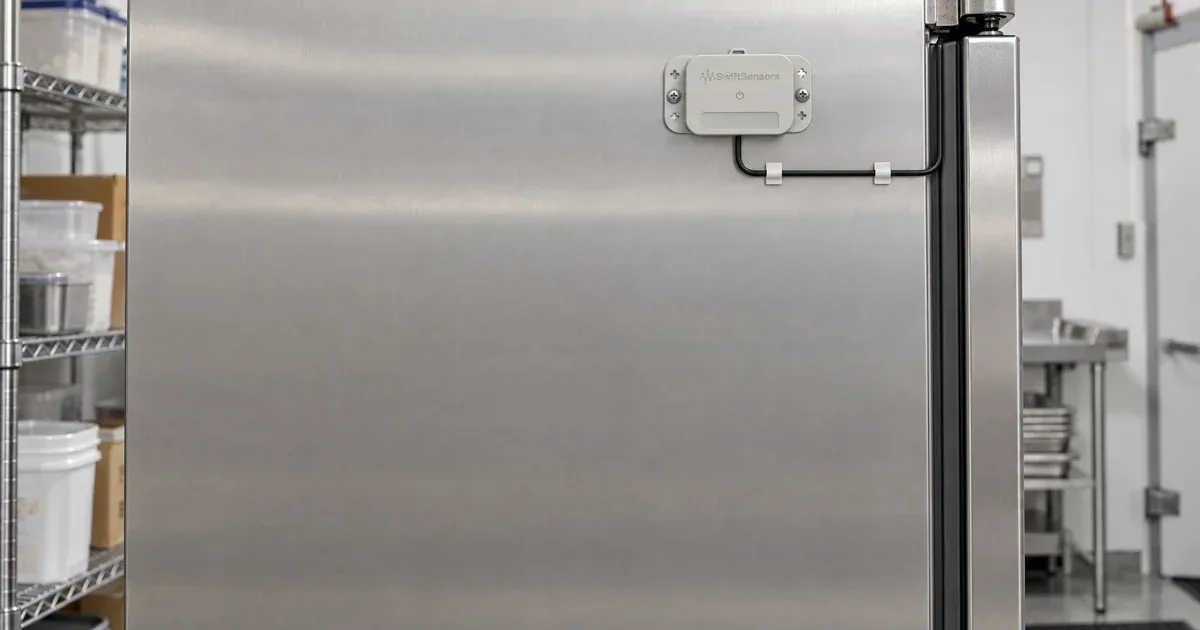
If your freezer alarm keeps going off while the temperature looks normal, the cause is usually a door, a defrost cycle, sensor placement, or a tight setting. Wireless temperature sensors help show which one by recording every reading. This guide sorts the four causes and shows how to quiet false alerts without going blind to a real failure.
By Ray Almgren, President and CEO, Swift Sensors
Why a Freezer Alarm Keeps Going Off When the Temperature Looks Fine
Alerts that cry wolf train people to ignore them. Then the one that matters lands in a muted inbox.
How does a freezer temperature monitor alarm differ from the appliance beep?
Two kinds of alarm are in play. The first is the audible alarm on the appliance, driven by its electronic controls: a door alarm when the door stays open, a high temperature alarm when the freezer compartment warms past its set temperature. A refrigerator or fridge freezer works the same way: an open alarm sounds when the door stays open, and a temperature alarm sounds when the cabinet warms. The second is a monitoring alert: Swift Sensors sends instant alerts via email, SMS or phone call whenever a reading goes out of range.
Both can fire when nothing is wrong. A restock, a long door opening or a defrost cycle warms the air for a few minutes, and the alarm reports it faithfully.
What are the four causes of false freezer temperature alerts?
Four causes account for most of the noise, and each leaves a different pattern in the readings.
| Cause | What the readings show | First fix |
|---|---|---|
| Door openings | A short spike that recovers soon after the door closes | Check the seals and latch, then review your alert thresholds and escalation tiers against normal recovery time |
| Defrost cycles | A rise at the same times every day | Match the tolerance to the defrost schedule |
| Sensor placement | A reading warmer or colder than the stored product | Move the sensor away from the door and the evaporator coil, to where product sits |
| Settings that are too tight | Alerts on small, harmless swings | Widen the threshold or tolerance in small steps |
A real failure is different: the line climbs and does not come back.
How Do Door Openings and Defrost Cycles Trigger a Freezer Alarm?
Every door opening lets warm room air rush in. A probe near the door sees that air first, so it reports a spike the stored product never felt. A door not fully latched makes it worse, because air keeps exchanging while the alarm keeps sounding. Worn seals and frost around the gasket are common reasons a door will not seat. A chest freezer alarm usually points to the lid, since a lid propped up by a stacked basket reads as an open door.
Defrost works the other way. Frost-free units, including the freezer compartment of a fridge freezer, run a heater now and then to clear frost off the evaporator coil. The air near the coil warms and freezer temperature rises for a while, then recovers. If your threshold sits just above the normal range, every defrost trips it. Blocked ventilation adds to both, and poor ventilation around the appliance makes the compressor work harder to recover.
Why does my freezer alarm go off at night?
Night alarms have a short list of suspects, because nobody is opening the door: an overnight defrost cycle, a door left ajar at closing, a heavy evening restock, or a power problem. When a freezer alarm keeps going off at night, the trend graph in the Swift Sensors Cloud Console shows whether the line recovered by itself (door or defrost) or kept climbing (equipment or power).
For power, an SS3-603 contact sensor can alert on power loss to a freezer or compressor, and a mini backup power supply can run a gateway for 12 to 15 hours.
How Do I Stop a Freezer Alarm From Going Off Without Turning Off Monitoring?
Tune it. Do not mute it. Work through these steps:
- Pull the last two weeks of readings and sort every alert that cleared on its own by cause.
- Fix the physical causes first: seals, latch, frost buildup, blocked ventilation, overloaded shelves.
- Adjust the threshold or tolerance only for causes you cannot remove, such as a scheduled defrost.
- Set alert escalation tiers so the first alert reaches the person nearest the freezer and later tiers reach a manager.
- Acknowledge each alert with a note on the graph, so the next shift knows what happened.
On the appliance, start troubleshooting issues with the cheapest checks. The alarm usually stops once the door closes or the temperature recovers. Most models also have switches or buttons on the electronic controls to silence the alarm sound or reset it, so follow the owner's manual. With a new fridge or a new fridge freezer, check the alarm settings in the manual first, since the electronic controls differ by model.
Can I silence a freezer alarm without missing a real failure?
Yes, if you silence the sound and keep the watch. Muting the sound on the unit quiets the temperature alarm in the room, while your monitoring alerts keep reaching people by email, SMS or phone call. Never disable the alert itself to get quiet.
What Alert Delay and Threshold Settings Reduce False Freezer Alarms?
Two things decide how noisy a freezer is. The threshold is the line a reading must cross. The second is how long a reading may stay across it before someone is called, which is where alert escalation tiers come in.
For food, the FDA advises holding freezers at 0 F (minus 18 C) or colder. For medications and other temperature-sensitive inventory, follow the manufacturer's storage guidance. Then set the tolerance from your own data: find the longest normal recovery after a door opening or defrost, and set it a little above.
How long should a freezer temperature alert delay be?
There is no single right number. Measure your own recovery time, add a margin, and review the result after two weeks of alerts. Use a shorter tolerance for can't-fail assets and a longer one for busy prep areas. Then compare it against the thresholds and escalation tiers in your own alert settings in the Swift Sensors Cloud Console.
What tolerance suits a walk-in freezer alarm?
A walk-in loaded from a delivery truck recovers more slowly than a reach-in opened by one person, so it needs a longer tolerance. Measure its recovery after a delivery, then add a margin.
Does a commercial freezer alarm need different settings?
The method is the same. A commercial unit usually sees more door traffic and holds more stock at risk, so escalation tiers matter more.
How Can You Tell a False Freezer Alarm From a Real Temperature Failure?
A freezer high temp alarm is either a pattern or a trend. Patterns are usually harmless. Trends are not.
- Likely false: the spike repeats at the same times, recovers within your normal window, and shows on one sensor only.
- Likely real: the freezer rises and keeps climbing, several units alert together, or the compressor is silent or running nonstop with no cooling.
- Check a second source: compare against a reference thermometer. A large disagreement points to the sensor or its placement, not the freezer.
When in doubt, treat it as real until the line comes back, because a temperature excursion can compromise temperature-sensitive inventory.
Is it safe to ignore a freezer alarm that keeps going off?
No. A repeating false alarm hides the day a real one fires. Find the cause, fix it or tune around it, and keep the alert live.
When should you replace a sensor or battery that keeps triggering alerts?
Investigate the sensor when it keeps dropping out while the freezer is fine, or when its readings disagree with a reference thermometer. Swift Sensors alerts when a sensor stops reporting, so a dropout arrives as its own alert. Metal freezer walls can weaken the signal, and gateway range is 100 m line of sight and 30 m without it, so moving the gateway closer often solves it.
If readings look off, calibration settles it: Swift Sensors provides NIST calibration through an independent ANAB ISO 17025:2017 accredited laboratory, with standard points from minus 50 C to plus 150 C, and a calibration report is part of the documentation.
Questions People Ask About Freezer Alarm Beeping
Why does my freezer alarm keep beeping?
The usual reasons are a door that is open or not fully seated, a freezer temperature above the set temperature, frost holding the door off its seals, or a power interruption.
Why is my freezer beeping with the door closed?
A door not fully latched, a stuck gasket or frost under the seal can leave a small gap the unit reads as open. Faulty door switches can trigger the door alarm on a fridge freezer or refrigerator in the same way.
How do I reset the alarm on my freezer?
Resetting depends on the model, so follow the owner's manual. Many units have an alarm or mute button that silences the alarm sound, and the alarm clears once the freezer temperature returns to the set temperature. If troubleshooting issues continue after that, check the door seals and ventilation before calling for service.
How long does it take for a fridge door alarm to go off?
It varies by model, and the manufacturer sets the delay. Your owner's manual lists the delay for your refrigerator or fridge freezer. A monitoring system works separately and alerts when readings go out of range.
What causes a freezer to keep running?
A compressor runs longer when it works to hold the set temperature. Leaking seals, heavy frost on the coil, blocked ventilation, frequent door openings, a warm room, or a set temperature colder than needed all add run time.
See What Your Freezers Are Really Doing
Swift Sensors gives your team continuous visibility into every freezer through cold chain monitoring, with instant alerts via email, SMS or phone call and no disruption to daily operations.

